Ch.16 Amines
McMurry - Fundamentals of General, Organic, and Biological Chemistry 8th Edition
McMurry8th EditionFundamentals of General, Organic, and Biological ChemistryISBN: 9780134015187Non è quello che usi tu?Cambia libro di testo
Capitolo 16, Problema 36c

Give names or structures for the following ammonium salts. Indicate whether each is the ammonium salt of a primary, secondary, or tertiary amine.
c. N-Butyl-N-isopropylhexylammonium chloride

Guida verificata passo dopo passo
1
Step 1: Understand the structure of the ammonium salt. The name 'N-Butyl-N-isopropylhexylammonium chloride' indicates that the compound is a quaternary ammonium salt, meaning the nitrogen atom is bonded to four alkyl groups and carries a positive charge, balanced by a chloride ion (Cl⁻).
Step 2: Break down the name into its components. 'N-Butyl' refers to a butyl group (C₄H₉) attached to the nitrogen atom. 'N-Isopropyl' refers to an isopropyl group (C₃H₇) attached to the nitrogen atom. 'Hexyl' refers to a hexyl group (C₆H₁₃) also attached to the nitrogen atom.
Step 3: Recognize the ammonium ion. Since the nitrogen atom is bonded to four alkyl groups (butyl, isopropyl, hexyl, and a fourth hydrogen atom), it forms a positively charged ammonium ion (R₄N⁺).
Step 4: Identify the counterion. The chloride ion (Cl⁻) is the counterion that balances the positive charge of the ammonium ion, forming the complete salt.
Step 5: Classify the amine type. Since the nitrogen atom is bonded to four groups (making it a quaternary ammonium ion), this is not a primary, secondary, or tertiary amine. Instead, it is a quaternary ammonium salt.

Risposta video verificata per un problema simile:

Questa soluzione video è stata consigliata dai nostri tutor come utile per risolvere questo problema.

Concetti chiave

Ecco i concetti essenziali che devi comprendere per rispondere correttamente alla domanda.

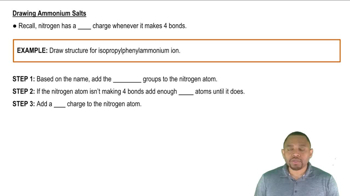
Ammonium Salts

Ammonium salts are ionic compounds formed from the protonation of an amine, resulting in a positively charged ammonium ion (NH4+). They typically consist of an ammonium cation and a negatively charged anion, such as chloride. Understanding the structure of ammonium salts is crucial for identifying their properties and applications in various chemical contexts.
Video consigliato:
Percorso guidato
1:04
Drawing Ammonium Salts Concept 2

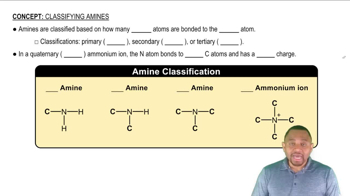
Amines Classification

Amines are classified based on the number of carbon groups attached to the nitrogen atom. Primary amines have one carbon group, secondary amines have two, and tertiary amines have three. This classification affects the reactivity and properties of the amines, which is essential for determining the type of ammonium salt formed when they are protonated.
Video consigliato:
Percorso guidato
1:26
Amine Classification Concept 1

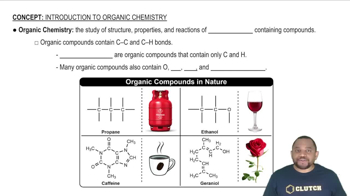
Nomenclature of Organic Compounds

The nomenclature of organic compounds follows specific rules set by the International Union of Pure and Applied Chemistry (IUPAC). For ammonium salts, the name typically reflects the structure of the amine and the anion. Understanding these naming conventions is vital for accurately identifying and communicating the chemical nature of compounds like N-Butyl-N-isopropylhexylammonium chloride.
Video consigliato:
Percorso guidato
2:26
Introduction to Organic Chemistry Concept 1