Ch.16 Amines
McMurry - Fundamentals of General, Organic, and Biological Chemistry 8th Edition
McMurry8th EditionFundamentals of General, Organic, and Biological ChemistryISBN: 9780134015187Non è quello che usi tu?Cambia libro di testo
Capitolo 16, Problema 17a

Write the structures of the following compounds:
a. Butyldiethylammonium bromide

Guida verificata passo dopo passo
1
Step 1: Understand the compound name. The name 'butyldiethylammonium bromide' indicates that it is a quaternary ammonium salt. The central atom is nitrogen, bonded to a butyl group, two ethyl groups, and a bromide ion as the counterion.
Step 2: Draw the butyl group. A butyl group is a four-carbon chain: CH₃-CH₂-CH₂-CH₂-. Attach this group to the nitrogen atom.
Step 3: Draw the two ethyl groups. An ethyl group is a two-carbon chain: CH₃-CH₂-. Attach two of these groups to the nitrogen atom.
Step 4: Add the positive charge to the nitrogen atom. Since the nitrogen is bonded to four groups (butyl, two ethyls, and a hydrogen is replaced), it carries a formal positive charge.
Step 5: Add the bromide ion (Br⁻) as the counterion to balance the positive charge on the nitrogen. This completes the structure of butyldiethylammonium bromide.

Risposta video verificata per un problema simile:

Questa soluzione video è stata consigliata dai nostri tutor come utile per risolvere questo problema.

Concetti chiave

Ecco i concetti essenziali che devi comprendere per rispondere correttamente alla domanda.

Quaternary Ammonium Compounds

Quaternary ammonium compounds are a class of chemicals that consist of a positively charged nitrogen atom bonded to four organic groups. In the case of butyldiethylammonium bromide, the nitrogen is bonded to a butyl group and two ethyl groups, making it a quaternary ammonium salt. These compounds are often used in various applications, including as surfactants and disinfectants.
Video consigliato:
Percorso guidato
3:26
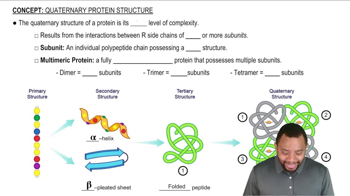
Quaternary Protein Structure Concept 1

Ionic Compounds

Ionic compounds are formed when atoms transfer electrons, resulting in the formation of charged ions. In butyldiethylammonium bromide, the butyldiethylammonium ion carries a positive charge, while the bromide ion carries a negative charge. The electrostatic attraction between these oppositely charged ions leads to the formation of a stable ionic compound.
Video consigliato:
Percorso guidato
02:11
Naming Ionic Compounds

Chemical Structure Representation

Chemical structure representation involves illustrating the arrangement of atoms within a molecule, including bonds and functional groups. For butyldiethylammonium bromide, the structure can be depicted using various methods such as Lewis structures or skeletal formulas, which help visualize the connectivity and spatial orientation of the atoms in the compound.
Video consigliato:
Percorso guidato
2:08
Molecular Representations Concept 1