
Cyclic ribose nucleotide phosphates, such as cyclic AMP (cAMP), are important signaling agents in living cells; all have the general structure shown here. What kind of linkage holds the phosphate to the ribose (see arrows; ribose is highlighted in blue)?
Ch.17 Carboxylic Acids and Their Derivatives
McMurry8th EditionFundamentals of General, Organic, and Biological ChemistryISBN: 9780134015187Non è quello che usi tu?Cambia libro di testo
Capitolo 17, Problema 69
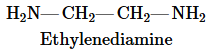
A simple polyamide can be made from ethylenediamine and oxalic acid (Table 17.1). Draw the polymer formed when three units of ethylenediamine reacts with two units of oxalic acid.

Guida verificata passo dopo passo1
Identify the functional groups in ethylenediamine and oxalic acid. Ethylenediamine contains two amine groups (-NH2), while oxalic acid contains two carboxylic acid groups (-COOH). These groups will react to form amide bonds (-CONH-).
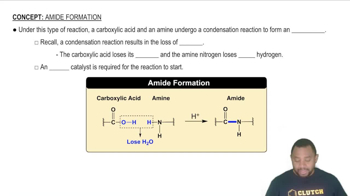
Understand the polymerization process. Each carboxylic acid group from oxalic acid reacts with an amine group from ethylenediamine, releasing a molecule of water (condensation reaction) and forming an amide bond.
Determine the sequence of the polymer. Since three units of ethylenediamine and two units of oxalic acid are involved, the polymer will alternate between the two monomers, starting and ending with ethylenediamine due to the stoichiometry.
Draw the repeating unit of the polymer. The repeating unit will consist of one ethylenediamine molecule connected to one oxalic acid molecule through amide bonds. Ensure that the terminal groups are correctly represented (an amine group at one end and a carboxylic acid group at the other).
Combine the repeating units to form the polymer. Link three ethylenediamine units and two oxalic acid units in the correct sequence, ensuring that each amide bond is properly formed and the polymer chain is continuous.

Risposta video verificata per un problema simile:
Questa soluzione video è stata consigliata dai nostri tutor come utile per risolvere questo problema.
Concetti chiave
Ecco i concetti essenziali che devi comprendere per rispondere correttamente alla domanda.
Polyamide Formation
Polyamides are a type of polymer formed through the reaction of diamines and dicarboxylic acids. In this case, ethylenediamine, a diamine, reacts with oxalic acid, a dicarboxylic acid, to create a repeating unit of the polymer. The reaction involves the formation of amide bonds, which link the monomers together, resulting in a long-chain structure characteristic of polyamides.
Video consigliato:
Percorso guidato
Amide Formation Concept 1
Condensation Reaction
The formation of polyamides from ethylenediamine and oxalic acid is a condensation reaction, where two molecules combine to form a larger molecule while releasing a small molecule, typically water. This process is crucial in polymer chemistry as it leads to the growth of the polymer chain. Understanding this reaction type is essential for predicting the structure and properties of the resulting polymer.
Video consigliato:
Percorso guidato
Condensed Formula Concept 1
Structural Representation of Polymers
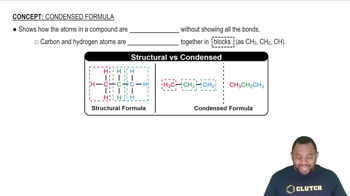
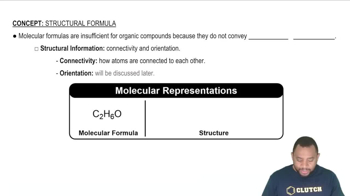
Drawing the polymer formed from the reaction requires an understanding of how to represent the repeating units and the overall structure of the polymer. This involves illustrating the backbone of the polymer, which consists of the amide linkages, and ensuring that the correct stoichiometry of the reactants is reflected in the final structure. Proper structural representation is key to visualizing the polymer's properties and potential applications.
Video consigliato:
Percorso guidato
Molecular Representations Concept 1
Pratica correlata
Domanda del libro di testo
38
views
Domanda del libro di testo
In the following compound
a. Identify the phosphate ester linkage.
34
views
Domanda del libro di testo
Household soap is a mixture of the sodium or potassium salts of long-chain carboxylic acids that arise from saponification of animal fat.
b. Draw the structures of the soap molecules produced in the following reaction:
641
views
Domanda del libro di testo
In the following compound
b. Identify the phosphate anhydride linkage.
38
views
Domanda del libro di testo
When both the carboxylic acid and the amine are in the same molecule, amide formation produces lactams. A lactam is a cyclic amide, where the amide group is part of the ring. Draw the structure of the product(s) obtained from acid hydrolysis of these lactams.
a.
756
views
