Ch.17 Carboxylic Acids and Their Derivatives
McMurry - Fundamentals of General, Organic, and Biological Chemistry 8th Edition
McMurry8th EditionFundamentals of General, Organic, and Biological ChemistryISBN: 9780134015187Non è quello che usi tu?Cambia libro di testo
Capitolo 17, Problema 47c

Draw structures corresponding to the following names:
c. 3,3-Dimethyl-4-phenylpentanoic acid

Guida verificata passo dopo passo
1
Step 1: Understand the name of the compound. The name '3,3-Dimethyl-4-phenylpentanoic acid' provides information about the structure. It is a carboxylic acid (indicated by the '-oic acid' suffix) with a pentane backbone (indicated by 'pentanoic').
Step 2: Start by drawing the main chain. The main chain is a five-carbon chain (pentane) with a carboxylic acid group (-COOH) attached to the first carbon. This makes it pentanoic acid.
Step 3: Add the substituents to the main chain. At carbon 3 of the pentane chain, there are two methyl groups (indicated by '3,3-Dimethyl'). Draw these two methyl groups branching off the third carbon.
Step 4: Add the phenyl group. At carbon 4 of the pentane chain, there is a phenyl group (indicated by '4-phenyl'). A phenyl group is a benzene ring attached as a substituent. Draw this benzene ring attached to the fourth carbon.
Step 5: Verify the structure. Ensure that the main chain has five carbons, the carboxylic acid group is on the first carbon, two methyl groups are on the third carbon, and a phenyl group is on the fourth carbon. Confirm that all carbons have the correct number of bonds (four for each carbon).

Risposta video verificata per un problema simile:

Questa soluzione video è stata consigliata dai nostri tutor come utile per risolvere questo problema.

Concetti chiave

Ecco i concetti essenziali che devi comprendere per rispondere correttamente alla domanda.

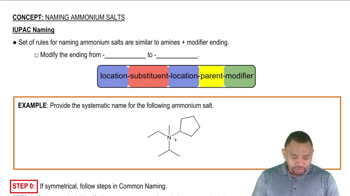
IUPAC Nomenclature

IUPAC nomenclature is a systematic method for naming chemical compounds. It provides a set of rules to derive the names of organic molecules based on their structure, including the identification of functional groups, the longest carbon chain, and substituents. Understanding these rules is essential for accurately interpreting and drawing chemical structures from their names.
Video consigliato:
Percorso guidato
3:18
IUPAC Naming Concept 3

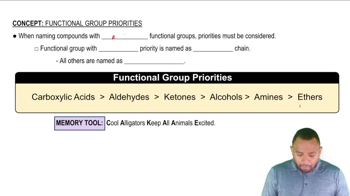
Functional Groups

Functional groups are specific groups of atoms within molecules that are responsible for the characteristic chemical reactions of those molecules. In the case of 3,3-Dimethyl-4-phenylpentanoic acid, the carboxylic acid group (-COOH) is the functional group that defines its acidic properties. Recognizing functional groups is crucial for predicting the behavior and reactivity of organic compounds.
Video consigliato:
Percorso guidato
1:11
Functional Group Priorities Concept 1

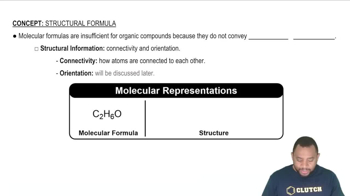
Structural Representation

Structural representation refers to the various ways in which the structure of a chemical compound can be depicted, including Lewis structures, condensed formulas, and skeletal formulas. For 3,3-Dimethyl-4-phenylpentanoic acid, accurately representing the branching of the carbon chain and the positioning of the phenyl and methyl groups is vital for visualizing the molecule's geometry and understanding its properties.
Video consigliato:
Percorso guidato
2:08
Molecular Representations Concept 1