
Phenacetin (shown in the margin) was once used in headache remedies but is now banned because of its potential for causing kidney damage. (a) Identify all the functional groups present in phenacetin. (b) Draw the structures of the carboxylic acid and amine needed to prepare phenacetin.
Ch.17 Carboxylic Acids and Their Derivatives
McMurry8th EditionFundamentals of General, Organic, and Biological ChemistryISBN: 9780134015187Non è quello che usi tu?Cambia libro di testo
Capitolo 17, Problema 20a
Draw structures of the amides that can be made from the following reactants:
a. CH3NH2 + (CH3)2CHCOOH →?
Guida verificata passo dopo passo1
Identify the functional groups in the reactants: CH₃NH₂ is a primary amine, and (CH₃)₂CHCOOH is a carboxylic acid. Amides are formed when an amine reacts with a carboxylic acid, typically through a condensation reaction where water (H₂O) is eliminated.
Determine the mechanism of the reaction: The amine (CH₃NH₂) will act as a nucleophile, attacking the carbonyl carbon of the carboxylic acid ((CH₃)₂CHCOOH). This forms a tetrahedral intermediate.
Recognize the elimination step: The tetrahedral intermediate will lose a molecule of water (H₂O), resulting in the formation of the amide bond (C=O-NH).
Draw the structure of the resulting amide: The amide will have the structure (CH₃)₂CH-C(=O)-NH-CH₃. The isopropyl group ((CH₃)₂CH-) comes from the carboxylic acid, and the methyl group (CH₃-) attached to the nitrogen comes from the amine.
Verify the product: Ensure that the product contains the amide functional group (-C(=O)-NH-) and that all atoms are accounted for from the reactants, with water (H₂O) as the byproduct.

Risposta video verificata per un problema simile:
Questa soluzione video è stata consigliata dai nostri tutor come utile per risolvere questo problema.
Durata del video:
2mConcetti chiave
Ecco i concetti essenziali che devi comprendere per rispondere correttamente alla domanda.
Amides
Amides are organic compounds derived from carboxylic acids where the hydroxyl group (-OH) is replaced by an amine group (-NH₂, -NHR, or -NR₂). They are characterized by the functional group -C(=O)N-, and are important in various biological processes, including protein synthesis. Understanding the structure of amides is crucial for predicting their reactivity and properties.
Video consigliato:
Percorso guidato
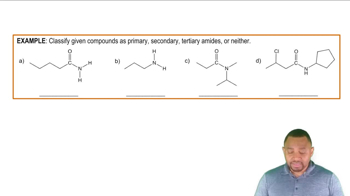
Intro to Amides Example 1
Carboxylic Acids
Carboxylic acids are organic compounds containing a carboxyl group (-COOH), which is responsible for their acidic properties. They can react with amines to form amides through a condensation reaction, where water is eliminated. Recognizing the structure and reactivity of carboxylic acids is essential for understanding how amides are synthesized.
Video consigliato:
Percorso guidato
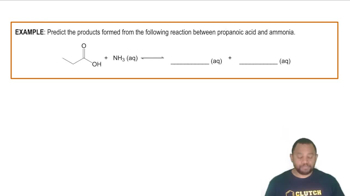
Carboxylic Acid Reactions Example 1
Condensation Reaction
A condensation reaction is a chemical process where two molecules combine to form a larger molecule, accompanied by the loss of a small molecule, often water. In the context of amide formation, the reaction between an amine and a carboxylic acid exemplifies this process. Grasping the concept of condensation reactions is vital for predicting the products formed in organic synthesis.
Video consigliato:
Percorso guidato
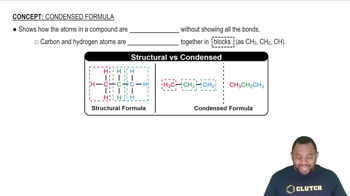
Condensed Formula Concept 1
Pratica correlata
Domanda del libro di testo
686
views
Domanda del libro di testo
Identify the following molecules as an ester, a carboxylic acid, or an amide, and write both the condensed and line-structural formula for each.
a. <IMAGE>
762
views
Domanda del libro di testo
Write the formulas of potassium salicylate and disodium oxalate.
507
views
Domanda del libro di testo
Draw the products you would obtain from acid-catalyzed hydrolysis of the following esters.
a. Isopropyl benzoate
631
views
Domanda del libro di testo
Write the products of the following reactions:
b. 2, 2-Dimethylpentanoic acid + KOH → ?
646
views
Domanda del libro di testo
Draw structures of the amides that can be made from the following reactants:
b.
754
views
