Ch.17 Carboxylic Acids and Their Derivatives
McMurry - Fundamentals of General, Organic, and Biological Chemistry 8th Edition
McMurry8th EditionFundamentals of General, Organic, and Biological ChemistryISBN: 9780134015187Non è quello che usi tu?Cambia libro di testo
Capitolo 17, Problema 59b

Give systematic names for the following structures and structures for the names:
b. N-Phenylacetamide

Guida verificata passo dopo passo
1
Step 1: Break down the name 'N-Phenylacetamide' into its components. The prefix 'N-' indicates that a substituent is attached to the nitrogen atom of the amide group. 'Phenyl' refers to a benzene ring (C₆H₅) as a substituent. 'Acetamide' is the parent compound, which consists of an amide group (-CONH₂) attached to a methyl group (CH₃).
Step 2: Identify the parent structure. The parent compound is 'acetamide,' which has the structure CH₃CONH₂. This is the simplest amide, with a methyl group attached to the carbonyl carbon.
Step 3: Attach the phenyl group to the nitrogen atom. The 'N-' prefix specifies that the phenyl group (C₆H₅) is bonded directly to the nitrogen atom of the amide group, replacing one of the hydrogen atoms on the nitrogen.
Step 4: Combine the components to construct the full structure. The final structure will have a benzene ring (C₆H₅) attached to the nitrogen atom of the amide group, and the carbonyl carbon will still be bonded to a methyl group (CH₃).
Step 5: Verify the systematic name. Ensure that the name 'N-Phenylacetamide' correctly describes the structure, with the phenyl group on the nitrogen and the acetamide group as the parent compound.

Risposta video verificata per un problema simile:

Questa soluzione video è stata consigliata dai nostri tutor come utile per risolvere questo problema.

Concetti chiave

Ecco i concetti essenziali che devi comprendere per rispondere correttamente alla domanda.

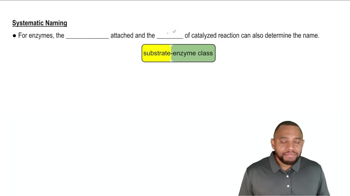
Systematic Naming in Chemistry

Systematic naming in chemistry refers to the IUPAC (International Union of Pure and Applied Chemistry) rules used to create unique and descriptive names for chemical compounds. This method ensures that each compound has a specific name that reflects its structure and composition, allowing for clear communication among chemists. For example, the name 'N-Phenylacetamide' indicates the presence of a phenyl group attached to the nitrogen of an acetamide.
Video consigliato:
Percorso guidato
0:38
Systematic Naming Concept 2

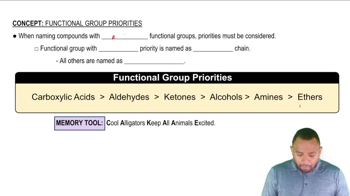
Functional Groups

Functional groups are specific groups of atoms within molecules that are responsible for the characteristic chemical reactions of those molecules. In the case of N-Phenylacetamide, the acetamide functional group (-CONH2) is crucial as it defines the compound's properties and reactivity. Recognizing functional groups is essential for understanding the behavior of organic compounds.
Video consigliato:
Percorso guidato
1:11
Functional Group Priorities Concept 1

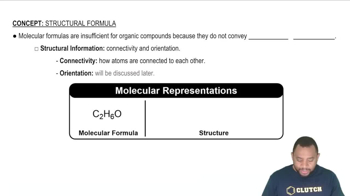
Structural Representation

Structural representation involves depicting the arrangement of atoms within a molecule, which can be illustrated through various formats such as Lewis structures, condensed formulas, or skeletal structures. For N-Phenylacetamide, a structural representation would show the acetamide backbone with the phenyl group attached to the nitrogen atom, providing insight into the compound's geometry and bonding.
Video consigliato:
Percorso guidato
2:08
Molecular Representations Concept 1