
Ch.17 Carboxylic Acids and Their Derivatives
McMurry - Fundamentals of General, Organic, and Biological Chemistry 8th Edition
McMurry8th EditionFundamentals of General, Organic, and Biological ChemistryISBN: 9780134015187Non è quello che usi tu?Cambia libro di testo
Capitolo 17, Problema 24a

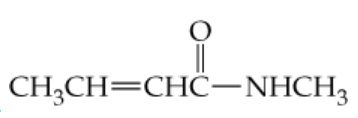
What carboxylic acids and amines result from hydrolysis of the following amides?
a. Chemical structure of an amide with a double bond, showing the molecular formula and functional groups.

Guida verificata passo dopo passo
1
Identify the functional groups in the given amide structure. Amides consist of a carbonyl group (C=O) directly bonded to a nitrogen atom (N). The hydrolysis of an amide involves breaking the bond between the carbonyl carbon and the nitrogen atom.
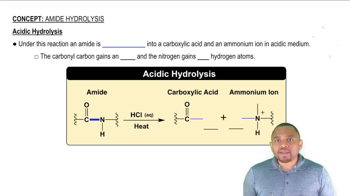
Understand the hydrolysis reaction. Hydrolysis of an amide can occur under acidic or basic conditions. In acidic hydrolysis, the amide reacts with water and an acid catalyst to produce a carboxylic acid and an amine salt. In basic hydrolysis, the amide reacts with a base to produce a carboxylate ion and a free amine.
Determine the products of hydrolysis. The carbonyl carbon of the amide becomes part of the carboxylic acid (or carboxylate ion in basic hydrolysis), while the nitrogen atom and its attached groups form the amine (or amine salt in acidic hydrolysis).
Examine the specific structure of the given amide (from the image) to identify the R groups attached to the carbonyl carbon and the nitrogen atom. These R groups will determine the specific carboxylic acid and amine produced.
Write the balanced chemical equation for the hydrolysis reaction, showing the amide as the reactant and the carboxylic acid and amine (or their respective forms under acidic/basic conditions) as the products. Use the identified R groups to complete the equation.

Risposta video verificata per un problema simile:

Questa soluzione video è stata consigliata dai nostri tutor come utile per risolvere questo problema.
Durata del video:
2m

Concetti chiave

Ecco i concetti essenziali che devi comprendere per rispondere correttamente alla domanda.

Hydrolysis of Amides

Hydrolysis of amides is a chemical reaction where an amide reacts with water, resulting in the formation of a carboxylic acid and an amine. This process typically requires an acid or base catalyst to facilitate the reaction. Understanding the structure of the amide is crucial, as it determines the specific carboxylic acid and amine produced.
Video consigliato:
Percorso guidato
1:12
Acidic Hydrolysis Concept 1

Carboxylic Acids

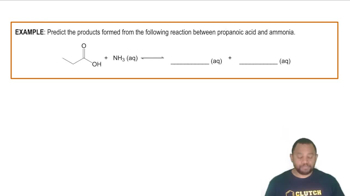
Carboxylic acids are organic compounds characterized by the presence of a carboxyl group (-COOH). They are known for their acidic properties and can be derived from the hydrolysis of amides. The specific carboxylic acid formed during hydrolysis depends on the alkyl or aryl group attached to the nitrogen in the amide.
Video consigliato:
Percorso guidato
1:09
Carboxylic Acid Reactions Example 1

Amines

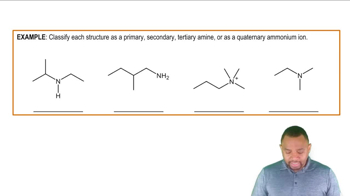
Amines are organic compounds derived from ammonia by replacing one or more hydrogen atoms with alkyl or aryl groups. They can be classified as primary, secondary, or tertiary based on the number of carbon-containing groups attached to the nitrogen atom. The type of amine produced during the hydrolysis of an amide is influenced by the structure of the original amide.
Video consigliato:
Percorso guidato
0:54
Amine Classification Example 1