
Ch.18 Amino Acids and Proteins
McMurry - Fundamentals of General, Organic, and Biological Chemistry 8th Edition
McMurry8th EditionFundamentals of General, Organic, and Biological ChemistryISBN: 9780134015187Non è quello che usi tu?Cambia libro di testo
Capitolo 18, Problema 59

How could you make the zwitterion of aspartic acid more soluble in water?

Guida verificata passo dopo passo
1
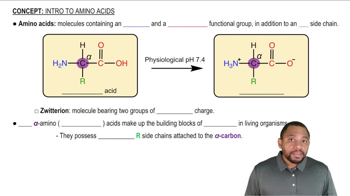
Understand the structure of aspartic acid: Aspartic acid is an amino acid with both an amino group (-NH₂) and a carboxylic acid group (-COOH), as well as a side chain containing a second carboxylic acid group. In its zwitterionic form, the amino group is protonated (-NH₃⁺) and one of the carboxylic acid groups is deprotonated (-COO⁻).
Recognize the solubility principle: Water is a polar solvent, so compounds with polar or charged groups tend to be more soluble in water. Increasing the number of charged groups on the molecule will enhance its solubility in water.
Adjust the pH of the solution: To increase the solubility of the zwitterion, adjust the pH to a level where both carboxylic acid groups are deprotonated (-COO⁻) and the amino group remains protonated (-NH₃⁺). This typically occurs at a pH above the isoelectric point of aspartic acid (around pH 2.8).
Explain the effect of pH: At a higher pH, the molecule will carry more negative charges due to the deprotonation of the carboxylic acid groups. This increases the molecule's overall polarity and enhances its interaction with water molecules, improving solubility.
Summarize the approach: To make the zwitterion of aspartic acid more soluble in water, increase the pH of the solution to a level where the molecule has more charged groups, ensuring it interacts more effectively with the polar water molecules.

Risposta video verificata per un problema simile:

Questa soluzione video è stata consigliata dai nostri tutor come utile per risolvere questo problema.

Concetti chiave

Ecco i concetti essenziali che devi comprendere per rispondere correttamente alla domanda.

Zwitterion

A zwitterion is a molecule that has both positive and negative charges, resulting in an overall neutral charge. In the case of amino acids like aspartic acid, the zwitterionic form occurs when the amino group is protonated (positively charged) and the carboxyl group is deprotonated (negatively charged). This dual charge allows zwitterions to interact favorably with polar solvents like water, enhancing their solubility.
Video consigliato:
Percorso guidato
3:04
Intro to Amino Acids Concept 1

Hydrophilicity

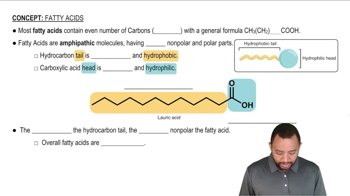
Hydrophilicity refers to the affinity of a substance for water, which is often due to the presence of polar functional groups that can form hydrogen bonds with water molecules. Increasing the hydrophilicity of aspartic acid's zwitterion can be achieved by modifying its structure to introduce more polar groups or by adjusting the pH to favor the zwitterionic form, thus enhancing its solubility in aqueous solutions.
Video consigliato:
Percorso guidato
2:00
Fatty Acids Concept 1

pH and Solubility

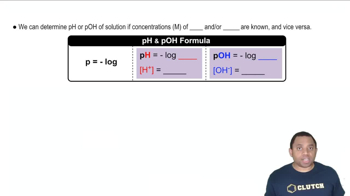
The pH of a solution can significantly affect the solubility of amino acids. For aspartic acid, at a pH close to its isoelectric point, the molecule exists predominantly in its zwitterionic form, which is more soluble in water. By manipulating the pH to be above or below this point, one can increase the proportion of the zwitterion, thereby improving its overall solubility in water.
Video consigliato:
Percorso guidato
02:09
pH and pOH Calculations