Ch.18 Amino Acids and Proteins
McMurry - Fundamentals of General, Organic, and Biological Chemistry 8th Edition
McMurry8th EditionFundamentals of General, Organic, and Biological ChemistryISBN: 9780134015187Non è quello che usi tu?Cambia libro di testo
Capitolo 18, Problema 77

Is the bond formed between each pair in Problem 18.76 covalent or noncovalent?
a. Cysteine and cysteine
b. Alanine and leucine
c. Aspartic acid and asparagine
d. Serine and lysine

Guida verificata passo dopo passo
1
Identify the elements in each pair from Problem 18.76 and determine their positions on the periodic table. This will help assess their electronegativity values.
Recall that a covalent bond is formed when two atoms share electrons, typically occurring between nonmetals with similar electronegativity values. Noncovalent interactions, on the other hand, include ionic bonds (formed between metals and nonmetals) and other weaker interactions like hydrogen bonds or van der Waals forces.
Compare the electronegativity values of the two elements in each pair. If the difference in electronegativity is small (generally less than 1.7), the bond is likely covalent. If the difference is large, the bond is likely ionic (a type of noncovalent interaction).
Consider the type of elements involved: if both are nonmetals, the bond is likely covalent. If one is a metal and the other is a nonmetal, the bond is likely ionic.
Classify each pair based on the above criteria, labeling the bond as covalent or noncovalent (ionic or other noncovalent interaction).

Risposta video verificata per un problema simile:

Questa soluzione video è stata consigliata dai nostri tutor come utile per risolvere questo problema.

Concetti chiave

Ecco i concetti essenziali che devi comprendere per rispondere correttamente alla domanda.

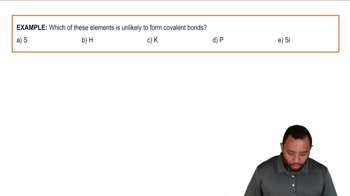
Covalent Bonds

Covalent bonds are formed when two atoms share one or more pairs of electrons, resulting in a stable balance of attractive and repulsive forces between the atoms. This type of bond typically occurs between nonmetals and is characterized by the strength and stability it provides to molecules. An example is the bond between hydrogen and oxygen in water (H2O).
Video consigliato:
Percorso guidato
01:04
Covalent Bonds Example 1

Noncovalent Interactions

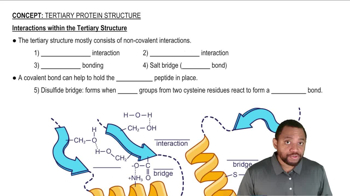
Noncovalent interactions are weaker than covalent bonds and do not involve the sharing of electrons. These interactions include hydrogen bonds, ionic bonds, van der Waals forces, and hydrophobic interactions. They play crucial roles in biological processes, such as the folding of proteins and the binding of substrates to enzymes.
Video consigliato:
Percorso guidato
2:41
Interactions within the Tertiary Structure Concept 2

Bond Polarity

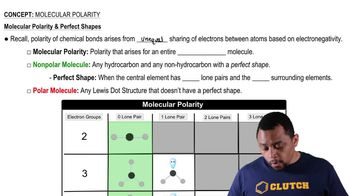
Bond polarity refers to the distribution of electrical charge over the atoms joined by the bond. In covalent bonds, if the atoms have different electronegativities, the shared electrons may be pulled closer to one atom, creating a polar covalent bond. Understanding bond polarity is essential for determining the nature of interactions between molecules, including whether they are covalent or noncovalent.
Video consigliato:
Percorso guidato
01:34
Molecular Polarity (Simplified) Concept 1