Ch.19 Enzymes and Vitamins
McMurry - Fundamentals of General, Organic, and Biological Chemistry 8th Edition
McMurry8th EditionFundamentals of General, Organic, and Biological ChemistryISBN: 9780134015187Non è quello che usi tu?Cambia libro di testo
Capitolo 19, Problema 10

What do we mean when we say an enzyme is saturated with substrate? When an enzyme is saturated with substrate, how does adding more (a) substrate and (b) enzyme affect the rate of the reaction?

Guida verificata passo dopo passo
1
Understand that enzyme saturation occurs when all active sites of the enzyme molecules are occupied by substrate molecules.
Recognize that at saturation, the reaction rate reaches its maximum velocity (V_max) because the enzyme is working at full capacity.
Consider the effect of adding more substrate: Since the enzyme is already saturated, adding more substrate will not increase the reaction rate further.
Consider the effect of adding more enzyme: Increasing the amount of enzyme provides more active sites, which can increase the reaction rate if more substrate is available to bind to these new sites.
Conclude that adding more substrate does not affect the rate at saturation, but adding more enzyme can increase the rate if substrate is not limiting.

Risposta video verificata per un problema simile:

Questa soluzione video è stata consigliata dai nostri tutor come utile per risolvere questo problema.
Durata del video:
4m

Concetti chiave

Ecco i concetti essenziali che devi comprendere per rispondere correttamente alla domanda.

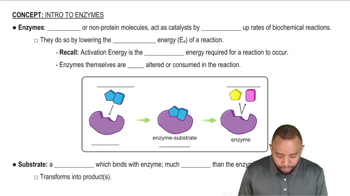
Enzyme Saturation

Enzyme saturation refers to the state when all active sites of an enzyme are occupied by substrate molecules. At this point, the enzyme is working at its maximum capacity, and the reaction rate reaches a plateau. This concept is crucial for understanding how enzymes function under varying substrate concentrations.
Video consigliato:
Percorso guidato
2:14
Intro to Enzymes Concept 1

Michaelis-Menten Kinetics

Michaelis-Menten kinetics describes the rate of enzymatic reactions by relating reaction rate to substrate concentration. It introduces parameters like Vmax (maximum reaction rate) and Km (substrate concentration at which the reaction rate is half of Vmax). This model helps predict how changes in substrate or enzyme concentration affect reaction rates.
Video consigliato:
Percorso guidato
01:19
Kinetic Molecular Theory Concept 1

Reaction Rate

The reaction rate is the speed at which reactants are converted into products in a chemical reaction. In the context of enzyme activity, the reaction rate can be influenced by substrate concentration, enzyme concentration, and environmental factors. Understanding how these variables interact is essential for predicting the effects of adding more substrate or enzyme.
Video consigliato:
Percorso guidato
01:07
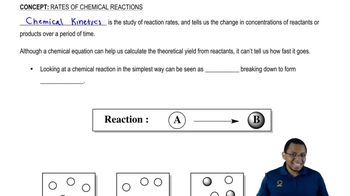
Rate of Reaction Concept 1