Ch.19 Enzymes and Vitamins
McMurry - Fundamentals of General, Organic, and Biological Chemistry 8th Edition
McMurry8th EditionFundamentals of General, Organic, and Biological ChemistryISBN: 9780134015187Non è quello che usi tu?Cambia libro di testo
Capitolo 19, Problema 36b

What general kinds of reactions do the following types of enzymes catalyze?
b. Decarboxylases

Guida verificata passo dopo passo
1
Understand the role of enzymes: Enzymes are biological catalysts that speed up chemical reactions in living organisms. Each enzyme is specific to a particular type of reaction.
Identify the type of enzyme: Decarboxylases are a specific class of enzymes that catalyze the removal of a carboxyl group (-COOH) from a molecule, releasing it as carbon dioxide (CO₂).
Recognize the reaction type: The reaction catalyzed by decarboxylases is a type of *decarboxylation reaction*, which involves the breakdown of a molecule by removing a carboxyl group.
Understand the general reaction: The general form of a decarboxylation reaction can be written as: R-COOH→R+CO2, where R represents the rest of the molecule.
Relate to biological processes: Decarboxylases are important in metabolic pathways, such as the citric acid cycle, where they help in the release of CO₂ as part of energy production in cells.

Risposta video verificata per un problema simile:

Questa soluzione video è stata consigliata dai nostri tutor come utile per risolvere questo problema.
Durata del video:
1m

Concetti chiave

Ecco i concetti essenziali che devi comprendere per rispondere correttamente alla domanda.

Enzymes

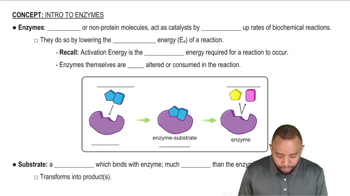
Enzymes are biological catalysts that speed up chemical reactions in living organisms. They lower the activation energy required for reactions, allowing processes to occur more efficiently. Each enzyme is specific to a particular substrate, meaning it catalyzes a specific reaction or type of reaction.
Video consigliato:
Percorso guidato
2:14
Intro to Enzymes Concept 1

Decarboxylases

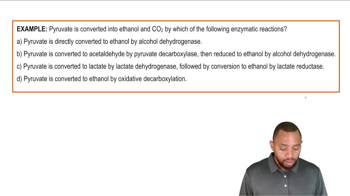
Decarboxylases are a specific class of enzymes that catalyze the removal of a carboxyl group (-COOH) from a substrate, releasing carbon dioxide (CO2) in the process. This reaction is crucial in various metabolic pathways, including the conversion of amino acids to amines and the decarboxylation of organic acids, playing a significant role in cellular respiration and energy production.
Video consigliato:
Percorso guidato
2:09
Anaerobic Respiration Example 2

Types of Reactions

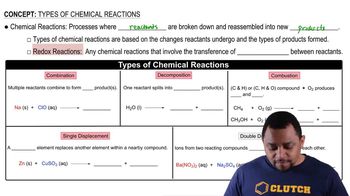
The types of reactions catalyzed by enzymes can be broadly categorized into several classes, including oxidation-reduction, hydrolysis, and decarboxylation. Understanding these categories helps in identifying the specific biochemical pathways in which enzymes like decarboxylases are involved, as they facilitate the transformation of substrates into products through distinct mechanisms.
Video consigliato:
Percorso guidato
04:07
Types of Chemical Reactions Concept 1