Ch.19 Enzymes and Vitamins
McMurry - Fundamentals of General, Organic, and Biological Chemistry 8th Edition
McMurry8th EditionFundamentals of General, Organic, and Biological ChemistryISBN: 9780134015187Non è quello che usi tu?Cambia libro di testo
Capitolo 19, Problema 87

Why are irreversible enzyme inhibitors referred to as poisons?

Guida verificata passo dopo passo
1
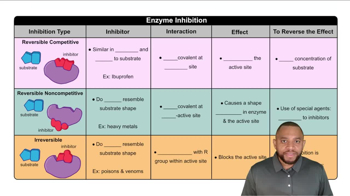
Irreversible enzyme inhibitors bind permanently to the active site of an enzyme, often forming covalent bonds, which prevents the enzyme from performing its catalytic function.
Enzymes are crucial for facilitating biochemical reactions in the body, and their inhibition can disrupt essential metabolic pathways.
When an enzyme is permanently inhibited, the body cannot easily replace it, leading to a buildup of substrates or a lack of necessary products, which can be toxic to cells and tissues.
Many irreversible inhibitors are toxic because they target enzymes critical for survival, such as those involved in energy production or neurotransmitter regulation.
This disruption of normal biochemical processes is why irreversible enzyme inhibitors are often referred to as poisons, as they can cause severe harm or even death depending on the enzyme they target.

Risposta video verificata per un problema simile:

Questa soluzione video è stata consigliata dai nostri tutor come utile per risolvere questo problema.
Durata del video:
3m

Concetti chiave

Ecco i concetti essenziali che devi comprendere per rispondere correttamente alla domanda.

Irreversible Enzyme Inhibition

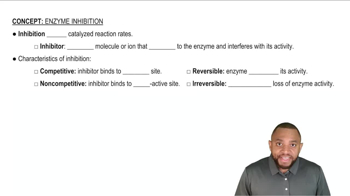
Irreversible enzyme inhibitors bind permanently to an enzyme, often through covalent bonds, rendering the enzyme inactive. This type of inhibition prevents the enzyme from catalyzing its reaction, which can lead to a complete loss of function. Unlike reversible inhibitors, which can dissociate from the enzyme, irreversible inhibitors create lasting changes that can significantly affect metabolic pathways.
Video consigliato:
Percorso guidato
1:19
Enzyme Inhibition Concept 1

Enzyme Function and Metabolism

Enzymes are biological catalysts that accelerate chemical reactions in living organisms, playing a crucial role in metabolism. They facilitate various biochemical processes, including digestion, energy production, and biosynthesis. When enzymes are inhibited, especially irreversibly, the metabolic pathways they regulate can be disrupted, leading to detrimental effects on cellular function and overall health.
Video consigliato:
Percorso guidato
02:16
Logarithmic Functions

Toxicology and Poisons

In toxicology, a poison is any substance that can cause harm or death to an organism when introduced in sufficient quantities. Irreversible enzyme inhibitors are often classified as poisons because they can lead to severe physiological consequences by permanently disabling essential enzymes. This can result in metabolic failure, organ dysfunction, or even death, depending on the enzyme affected and the organism's reliance on its function.
Video consigliato:
Percorso guidato
3:26
Enzyme Inhibition Concept 2