Ch.20 Carbohydrates
McMurry - Fundamentals of General, Organic, and Biological Chemistry 8th Edition
McMurry8th EditionFundamentals of General, Organic, and Biological ChemistryISBN: 9780134015187Non è quello che usi tu?Cambia libro di testo
Capitolo 20, Problema 6b

Draw the enantiomer of the following monosaccharides, and in each pair identify the D sugar and the L sugar.
b. Structural representation of a monosaccharide, showing its enantiomer with labeled D and L sugars.

Guida verificata passo dopo passo
1
Understand the concept of enantiomers: Enantiomers are stereoisomers that are non-superimposable mirror images of each other. In the context of monosaccharides, this involves flipping the configuration of all chiral centers in the molecule.
Identify the chiral centers in the given monosaccharide structure. Chiral centers are carbon atoms bonded to four different groups. For monosaccharides, these are typically the carbons in the backbone (except the terminal ones in most cases).
Draw the enantiomer by reversing the configuration at each chiral center. For example, if a hydroxyl group (-OH) is on the right side of a chiral carbon in the Fischer projection, place it on the left side in the enantiomer, and vice versa.
Determine the D or L designation for each sugar. This is based on the configuration of the chiral carbon furthest from the carbonyl group (the penultimate carbon). If the hydroxyl group on this carbon is on the right in the Fischer projection, the sugar is a D-sugar; if it is on the left, it is an L-sugar.
Label the original monosaccharide and its enantiomer as D or L based on the above determination. Remember, D and L designations do not indicate optical rotation but rather the spatial arrangement of groups around the chiral center.

Risposta video verificata per un problema simile:

Questa soluzione video è stata consigliata dai nostri tutor come utile per risolvere questo problema.
Durata del video:
3m

Concetti chiave

Ecco i concetti essenziali che devi comprendere per rispondere correttamente alla domanda.

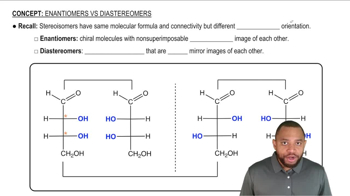
Enantiomers

Enantiomers are a type of stereoisomer that are non-superimposable mirror images of each other. They occur in molecules that have chiral centers, where the arrangement of atoms around the chiral center leads to two distinct configurations. In the context of monosaccharides, enantiomers can significantly affect the properties and biological activity of the sugars.
Video consigliato:
Percorso guidato
3:33
Enantiomers vs Diastereomers Concept 1

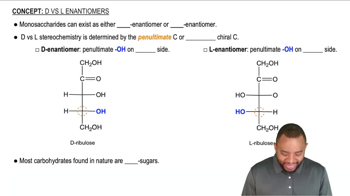
D and L Configuration

The D and L notation is used to designate the configuration of sugars based on the orientation of the hydroxyl (-OH) group on the penultimate carbon (the second to last carbon). If the -OH group is on the right in a Fischer projection, the sugar is classified as D; if it is on the left, it is classified as L. This classification is crucial for understanding the sugar's behavior in biological systems.
Video consigliato:
Percorso guidato
1:30
D vs L Enantiomers Concept 1

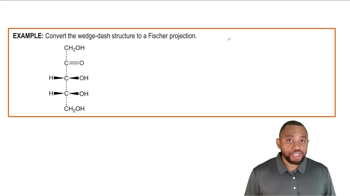
Fischer Projection

A Fischer projection is a two-dimensional representation of a three-dimensional organic molecule, particularly useful for depicting the stereochemistry of sugars and amino acids. In this format, vertical lines represent bonds that go back into the plane, while horizontal lines represent bonds that come out of the plane. Understanding Fischer projections is essential for accurately drawing and interpreting the structures of monosaccharides and their enantiomers.
Video consigliato:
Percorso guidato
0:48
Fischer Projections Example 1