Ch.20 Carbohydrates
McMurry - Fundamentals of General, Organic, and Biological Chemistry 8th Edition
McMurry8th EditionFundamentals of General, Organic, and Biological ChemistryISBN: 9780134015187Non è quello che usi tu?Cambia libro di testo
Capitolo 20, Problema 40

Only three stereoisomers are possible for 2,3-dibromo-2, 3-dichlorobutane. Draw them, indicating which pair are enantiomers (optical isomers). Why does the other isomer not have an enantiomer?

Guida verificata passo dopo passo
1
Step 1: Understand the structure of 2,3-dibromo-2,3-dichlorobutane. The molecule has a butane backbone with bromine (Br) and chlorine (Cl) atoms attached to the second and third carbon atoms. These carbons are chiral centers because they are bonded to four different groups.
Step 2: Draw the possible stereoisomers. Since there are two chiral centers, each can have two configurations (R or S). This gives a maximum of 2^2 = 4 stereoisomers. However, due to symmetry in the molecule, only three unique stereoisomers exist.
Step 3: Identify the enantiomers. Enantiomers are non-superimposable mirror images of each other. Draw the pair of stereoisomers where the configurations of the two chiral centers are opposite (e.g., (R,R) and (S,S)). These are the enantiomers.
Step 4: Identify the meso compound. The third stereoisomer is a meso compound, which has an internal plane of symmetry. This symmetry makes it superimposable on its mirror image, meaning it does not have an enantiomer.
Step 5: Explain why the meso compound lacks an enantiomer. The internal symmetry of the meso compound cancels out optical activity, making it achiral. As a result, it is identical to its mirror image and does not have a distinct enantiomer.

Risposta video verificata per un problema simile:

Questa soluzione video è stata consigliata dai nostri tutor come utile per risolvere questo problema.
Durata del video:
2m

Concetti chiave

Ecco i concetti essenziali che devi comprendere per rispondere correttamente alla domanda.

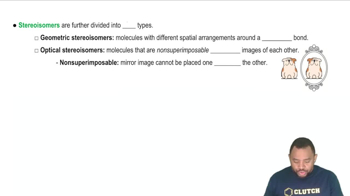
Stereoisomers

Stereoisomers are compounds that have the same molecular formula and connectivity of atoms but differ in the spatial arrangement of those atoms. This category includes enantiomers, which are non-superimposable mirror images of each other, and diastereomers, which are not mirror images. Understanding stereoisomers is crucial for analyzing the optical activity and reactivity of compounds.
Video consigliato:
Percorso guidato
1:56
Stereoisomers Concept 2

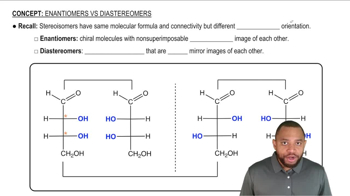
Enantiomers

Enantiomers are a specific type of stereoisomer that are mirror images of each other and cannot be superimposed. They typically arise in chiral molecules, which have at least one carbon atom bonded to four different substituents. Enantiomers often exhibit different optical activities, meaning they rotate plane-polarized light in opposite directions, which is significant in fields like pharmaceuticals.
Video consigliato:
Percorso guidato
3:33
Enantiomers vs Diastereomers Concept 1

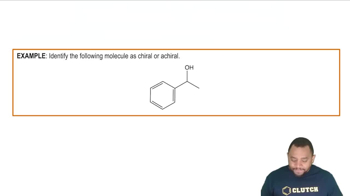
Chirality

Chirality refers to the geometric property of a molecule that makes it non-superimposable on its mirror image, akin to how left and right hands are mirror images but not identical. A chiral center, usually a carbon atom with four different substituents, is essential for the formation of enantiomers. In the case of 2,3-dibromo-2,3-dichlorobutane, the presence of two chiral centers leads to the formation of stereoisomers, but not all configurations will yield enantiomers.
Video consigliato:
Percorso guidato
1:39
Chirality Example 1