Ch.20 Carbohydrates
McMurry - Fundamentals of General, Organic, and Biological Chemistry 8th Edition
McMurry8th EditionFundamentals of General, Organic, and Biological ChemistryISBN: 9780134015187Non è quello che usi tu?Cambia libro di testo
Capitolo 20, Problema 53

Reduction of D-fructose with a reducing agent yields a mixture of D-sorbitol along with a second, isomeric product. What is the structure of the second product?

Guida verificata passo dopo passo
1
Understand the context: Reduction of D-fructose involves the addition of hydrogen (H₂) to the carbonyl group (C=O) in the sugar molecule, converting it into an alcohol group (-OH). This process is typically carried out using a reducing agent such as sodium borohydride (NaBH₄) or hydrogen gas with a catalyst.
Identify the structure of D-fructose: D-fructose is a ketohexose, meaning it contains six carbons and a ketone group at the second carbon (C2). The ketone group is the functional group that will be reduced.
Determine the products of reduction: Reduction of the ketone group in D-fructose can yield two different products because the ketone group is located at C2, which is adjacent to a chiral center (C3). Reduction can produce either D-sorbitol (a sugar alcohol derived from D-glucose) or another isomeric sugar alcohol.
Explain the formation of the second product: The second product is D-mannitol, which forms when the reduction of the ketone group leads to the formation of a hydroxyl group (-OH) with the opposite stereochemistry at C2 compared to D-sorbitol. This occurs because the reduction process can produce a racemic mixture at the C2 position.
Summarize the structures: The two products of the reduction of D-fructose are D-sorbitol (with the same stereochemistry as D-glucose) and D-mannitol (with the stereochemistry of D-mannose). Both are sugar alcohols, differing only in the configuration of the hydroxyl group at C2.

Risposta video verificata per un problema simile:

Questa soluzione video è stata consigliata dai nostri tutor come utile per risolvere questo problema.
Durata del video:
2m

Concetti chiave

Ecco i concetti essenziali che devi comprendere per rispondere correttamente alla domanda.

Reduction of Sugars

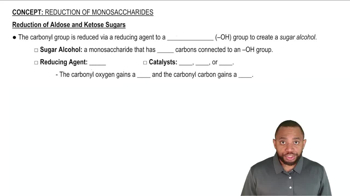
Reduction of sugars involves the conversion of carbonyl groups (aldehydes or ketones) into alcohols using reducing agents. In the case of d-fructose, a ketose sugar, reduction leads to the formation of d-sorbitol, an alditol. Understanding this process is crucial for predicting the products of sugar reduction.
Video consigliato:
Percorso guidato
0:50
Reduction of Monosaccharides Concept 1

Isomerism

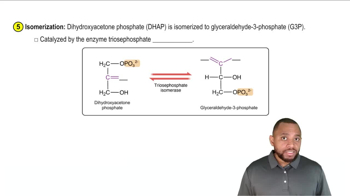
Isomerism refers to the existence of compounds with the same molecular formula but different structural arrangements or spatial orientations. In the context of d-fructose reduction, the second product formed alongside d-sorbitol is likely to be an isomer, such as d-mannitol, which has a different configuration at one or more carbon atoms.
Video consigliato:
Percorso guidato
1:26
Glycolysis Concept 5

Structural Representation of Sugars

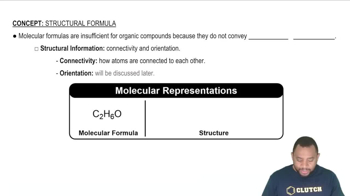
Structural representation of sugars involves depicting their molecular structure, including the arrangement of atoms and functional groups. For d-fructose and its reduction products, understanding how to draw and interpret Fischer projections or Haworth structures is essential for identifying the second product's structure and its relationship to d-sorbitol.
Video consigliato:
Percorso guidato
2:08
Molecular Representations Concept 1