Ch.21 The Generation of Biochemical Energy
McMurry - Fundamentals of General, Organic, and Biological Chemistry 8th Edition
McMurry8th EditionFundamentals of General, Organic, and Biological ChemistryISBN: 9780134015187Non è quello che usi tu?Cambia libro di testo
Capitolo 21, Problema 49a

FAD is a coenzyme for dehydrogenation.
a. When a molecule is dehydrogenated, is FAD oxidized or reduced?

Guida verificata passo dopo passo
1
Understand the concept of dehydrogenation: Dehydrogenation is a chemical reaction in which hydrogen atoms are removed from a molecule. This process typically involves the transfer of electrons and protons.
Recall the role of FAD (Flavin Adenine Dinucleotide): FAD is a coenzyme that participates in redox reactions, meaning it can either accept or donate electrons during these reactions.
Determine what happens to FAD during dehydrogenation: When a molecule is dehydrogenated, it loses hydrogen atoms (which include electrons). These electrons are transferred to FAD, meaning FAD gains electrons.
Apply the definition of reduction: Reduction is the gain of electrons. Since FAD gains electrons during dehydrogenation, it is reduced in the process.
Conclude the answer: FAD is reduced when a molecule is dehydrogenated because it accepts electrons from the molecule undergoing the reaction.

Risposta video verificata per un problema simile:

Questa soluzione video è stata consigliata dai nostri tutor come utile per risolvere questo problema.
Durata del video:
2m

Concetti chiave

Ecco i concetti essenziali che devi comprendere per rispondere correttamente alla domanda.

Dehydrogenation

Dehydrogenation is a chemical reaction that involves the removal of hydrogen atoms from a molecule. This process typically results in the oxidation of the substrate, as it loses electrons along with the hydrogen. Dehydrogenation is crucial in metabolic pathways, particularly in cellular respiration, where it helps convert substrates into energy-rich molecules.

FAD as a Coenzyme

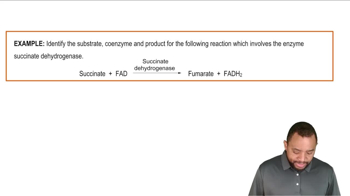
FAD (flavin adenine dinucleotide) is a coenzyme that plays a vital role in various biological oxidation-reduction reactions. It acts as an electron carrier, accepting electrons during the dehydrogenation process. When FAD accepts electrons, it is reduced to FADH2, which can later donate these electrons in the electron transport chain to produce ATP.
Video consigliato:
Percorso guidato
1:07
Intro to Coenzymes Example 1

Oxidation and Reduction

Oxidation and reduction are complementary chemical processes that involve the transfer of electrons between substances. Oxidation refers to the loss of electrons (or hydrogen), while reduction refers to the gain of electrons (or hydrogen). In the context of dehydrogenation, the substrate is oxidized, and FAD is reduced, highlighting the interconnected nature of these reactions in metabolic pathways.
Video consigliato:
Percorso guidato
0:55
Reduction of Monosaccharides Example 1