Ch.21 The Generation of Biochemical Energy
McMurry - Fundamentals of General, Organic, and Biological Chemistry 8th Edition
McMurry8th EditionFundamentals of General, Organic, and Biological ChemistryISBN: 9780134015187Non è quello che usi tu?Cambia libro di testo
Capitolo 21, Problema 24c

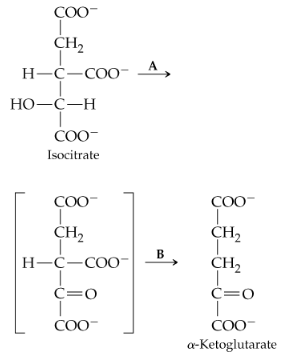
The reaction that follows is catalyzed by isocitrate dehydrogenase and occurs in two steps, the first of which (step A) is formation of an unstable intermediates (shown in brackets).

c. Which of the structures shown can be described as a β-keto acid?

Guida verificata passo dopo passo
1
Step 1: Understand the term 'ß-keto acid'. A ß-keto acid is a molecule that contains both a ketone group (C=O) and a carboxylic acid group (-COOH), where the ketone group is located on the carbon atom that is beta (two carbons away) from the carboxylic acid group.
Step 2: Examine the structures provided in the problem. Identify the functional groups present in each structure, specifically looking for a ketone group and a carboxylic acid group.
Step 3: Determine the relative positions of the ketone group and the carboxylic acid group in each structure. Check if the ketone group is located on the beta carbon relative to the carboxylic acid group.
Step 4: Identify the structure(s) that meet the criteria for a ß-keto acid. This involves confirming that the ketone group is exactly two carbons away from the carboxylic acid group.
Step 5: Conclude which structure(s) can be described as a ß-keto acid based on the analysis of their functional groups and relative positions.

Risposta video verificata per un problema simile:

Questa soluzione video è stata consigliata dai nostri tutor come utile per risolvere questo problema.
Durata del video:
3m

Concetti chiave

Ecco i concetti essenziali che devi comprendere per rispondere correttamente alla domanda.

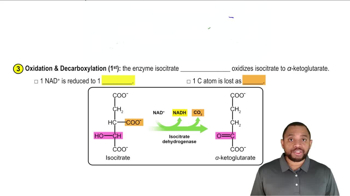
Isocitrate Dehydrogenase

Isocitrate dehydrogenase is an enzyme that plays a crucial role in the citric acid cycle (Krebs cycle), catalyzing the oxidative decarboxylation of isocitrate to alpha-ketoglutarate. This reaction is significant for energy production and metabolic regulation. Understanding its function helps in grasping how intermediates are formed and transformed during cellular respiration.
Video consigliato:
Percorso guidato
1:47
Phase B - Succinyl CoA Formation Concept 5

ß-Keto Acid

A ß-keto acid is a type of organic compound that contains a ketone group (C=O) at the beta position relative to a carboxylic acid group (–COOH). This structure is important in various biochemical pathways, including metabolism and the synthesis of amino acids. Identifying ß-keto acids is essential for understanding their role in metabolic reactions and their potential as intermediates.
Video consigliato:

Unstable Intermediates

Unstable intermediates are transient species formed during chemical reactions that have a short lifespan and are often highly reactive. In enzymatic reactions, these intermediates can influence the reaction pathway and the overall kinetics. Recognizing these intermediates is vital for understanding the mechanisms of enzyme-catalyzed reactions and the stability of the products formed.
Video consigliato:
Percorso guidato
0:35
Overview of Protein Synthesis Example 1
Pratica correlata
Domanda del libro di testo

What energy requirements must be met in order for a reaction to be favorable?

810
views

Domanda del libro di testo

The reaction that follows is catalyzed by isocitrate dehydrogenase and occurs in two steps, the first of which (step A) is formation of an unstable intermediates (shown in brackets).

d. To what class of enzymes does isocitrate dehydrogenase, the enzyme that catalyzes this reaction, belong?

1217
views
Domanda del libro di testo

The reaction that follows is catalyzed by isocitrate dehydrogenase and occurs in two steps, the first of which (step A) is formation of an unstable intermediates (shown in brackets).

a. In which step is a coenzyme needed? Identify the coenzyme.

834
views
Domanda del libro di testo

Since no molecular oxygen participates in the citric acid cycle, the steps in which acetyl groups are oxidized to CO2 involve removal of hydride ions and hydrogen ions. What is the acceptor of hydride ions? What is the acceptor of hydrogen ions?

661
views
Domanda del libro di testo

The reaction that follows is catalyzed by isocitrate dehydrogenase and occurs in two steps, the first of which (step A) is formation of an unstable intermediates (shown in brackets).

b. In which step is CO2 evolved and a hydrogen ion added?

912
views
Domanda del libro di testo

The electron-transport chain uses several different metal ions, especially iron, copper, zinc, and manganese. Why are metals used frequently in these two pathways? What can metals do better than organic biomolecules?

1265
views