Ch.22 Carbohydrate Metabolism
McMurry - Fundamentals of General, Organic, and Biological Chemistry 8th Edition
McMurry8th EditionFundamentals of General, Organic, and Biological ChemistryISBN: 9780134015187Non è quello che usi tu?Cambia libro di testo
Capitolo 22, Problema 77

Why is it important for the cell that the NADH produced when pyruvate is converted to lactate be converted back to NAD+?

Guida verificata passo dopo passo
1
Understand the context: During anaerobic conditions (low oxygen), cells rely on glycolysis to produce ATP. Glycolysis requires NAD⁺ as a coenzyme to accept electrons during the oxidation of glucose to pyruvate.
Recognize the issue: If NAD⁺ is not regenerated, glycolysis will stop because there will be no NAD⁺ available to accept electrons, halting ATP production and leading to energy depletion in the cell.
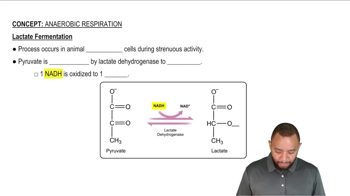
Explain the role of lactate formation: When pyruvate is converted to lactate by the enzyme lactate dehydrogenase, NADH is oxidized back to NAD⁺. This reaction ensures a continuous supply of NAD⁺ for glycolysis to proceed.
Connect to cellular survival: The regeneration of NAD⁺ is critical for maintaining ATP production under anaerobic conditions, which is especially important for cells like muscle cells during intense exercise or for cells in low-oxygen environments.
Summarize the importance: The conversion of NADH to NAD⁺ during lactate formation is a key step in sustaining energy production and preventing metabolic shutdown in the absence of oxygen.

Risposta video verificata per un problema simile:

Questa soluzione video è stata consigliata dai nostri tutor come utile per risolvere questo problema.
Durata del video:
2m

Concetti chiave

Ecco i concetti essenziali che devi comprendere per rispondere correttamente alla domanda.

NADH and NAD⁺ Role in Metabolism

NADH and NAD⁺ are crucial coenzymes in cellular metabolism, particularly in redox reactions. NADH acts as a reducing agent, donating electrons during metabolic processes, while NAD⁺ serves as an oxidizing agent, accepting electrons. The interconversion between these two forms is vital for maintaining the balance of redox reactions in the cell.
Video consigliato:
Percorso guidato
1:20
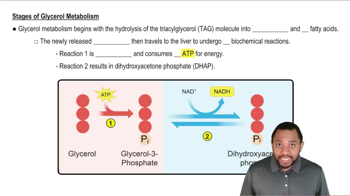
Glycerol Metabolism Concept 2

Lactate Fermentation

Lactate fermentation is an anaerobic process where pyruvate is converted to lactate, allowing glycolysis to continue in the absence of oxygen. This process regenerates NAD⁺ from NADH, which is essential for glycolysis to produce ATP. Without this regeneration, glycolysis would halt, leading to a lack of energy production in the cell.
Video consigliato:
Percorso guidato
1:14
Anaerobic Respiration Concept 3

Cellular Energy Production

Cellular energy production primarily occurs through glycolysis, the Krebs cycle, and oxidative phosphorylation. In anaerobic conditions, the conversion of pyruvate to lactate ensures that glycolysis can continue by replenishing NAD⁺. This is critical for cells, especially muscle cells during intense exercise, to sustain ATP production when oxygen is limited.
Video consigliato:
Percorso guidato
1:08
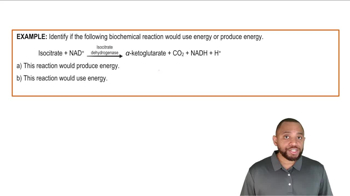
Energy Production In Biochemical Pathways Example 1