
Ch.23 Lipids
McMurry - Fundamentals of General, Organic, and Biological Chemistry 8th Edition
McMurry8th EditionFundamentals of General, Organic, and Biological ChemistryISBN: 9780134015187Non è quello che usi tu?Cambia libro di testo
Capitolo 23, Problema 58

Why are glycerophospholipids more soluble in water than triacylglycerols?

Guida verificata passo dopo passo
1
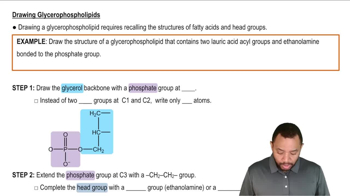
Understand the structure of glycerophospholipids: These molecules consist of a glycerol backbone, two fatty acid chains, and a phosphate group attached to a polar head group. The phosphate group and polar head group make the molecule amphipathic, meaning it has both hydrophilic (water-attracting) and hydrophobic (water-repelling) regions.
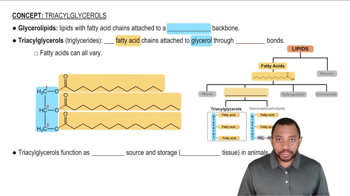
Understand the structure of triacylglycerols: These molecules consist of a glycerol backbone and three fatty acid chains. They are nonpolar and hydrophobic, meaning they do not interact well with water.
Compare the solubility in water: Glycerophospholipids have a polar head group due to the phosphate group, which can form hydrogen bonds and interact with water molecules. This makes them more soluble in water compared to triacylglycerols, which lack a polar region and are entirely hydrophobic.
Relate solubility to amphipathic nature: The amphipathic nature of glycerophospholipids allows them to align at water interfaces, with their hydrophilic heads interacting with water and their hydrophobic tails avoiding it. This property enhances their solubility in aqueous environments.
Conclude the reasoning: The presence of the polar phosphate group and the amphipathic nature of glycerophospholipids make them more soluble in water than triacylglycerols, which are purely hydrophobic and lack any polar functional groups.

Risposta video verificata per un problema simile:

Questa soluzione video è stata consigliata dai nostri tutor come utile per risolvere questo problema.
Durata del video:
2m

Concetti chiave

Ecco i concetti essenziali che devi comprendere per rispondere correttamente alla domanda.

Glycerophospholipids Structure

Glycerophospholipids are composed of a glycerol backbone, two fatty acid tails, and a phosphate group. The presence of the phosphate group, which is polar and hydrophilic, allows glycerophospholipids to interact favorably with water molecules, enhancing their solubility in aqueous environments.
Video consigliato:
Percorso guidato
2:32
Glycerophospholipids Example 3

Triacylglycerols Structure

Triacylglycerols, or triglycerides, consist of a glycerol molecule bonded to three fatty acid chains. These fatty acids are typically long and hydrophobic, making triacylglycerols largely nonpolar and less soluble in water. Their structure is primarily designed for energy storage rather than solubility.
Video consigliato:
Percorso guidato
1:52
Triacylglycerols Concept 1

Hydrophilicity vs. Hydrophobicity

Hydrophilicity refers to the affinity of a molecule for water, while hydrophobicity indicates a lack of such affinity. Glycerophospholipids, with their polar head groups, are hydrophilic, allowing them to dissolve in water, whereas triacylglycerols are hydrophobic due to their long nonpolar fatty acid chains, leading to poor solubility in water.
Video consigliato:
Percorso guidato
3:33
Enantiomers vs Diastereomers Concept 1
Pratica correlata
Domanda del libro di testo

Dietary guidelines suggest we limit our intake of butter due to the cholesterol content and substitute oils or margarine. The following table shows the major fatty acid distribution for a typical stick of margarine and also for butter. Values are percentages.

c. Which is likely to contain fewer trans-fatty acids

644
views
Domanda del libro di testo

Draw the structure of a glycerophospholipid that contains palmitic acid, oleic acid, and the phosphate bonded to propanolamine.

885
views
Domanda del libro di testo

Cardiolipin, a compound found in heart muscle, has the following structure. What products are formed if all ester bonds in the molecule are saponified by treatment with aqueous NaOH?

742
views
Domanda del libro di testo

Dietary guidelines suggest we limit our intake of butter due to the cholesterol content and substitute oils or margarine. The following table shows the major fatty acid distribution for a typical stick of margarine and also for butter. Values are percentages.

a. Which contains more monounsaturated fatty acids?

660
views
Domanda del libro di testo

Show the structure of a cerebroside made up of D-galactose, sphingosine, and myristic acid.

806
views
Domanda del libro di testo

Tell how many different products you would obtain on hydrogenation of the triacylglycerol in Problem 23.49 if:

a. One double bond was converted to a single bond

b. Two double bonds were converted to single bonds

c. Three double bonds were converted to single bonds

d. All four double bonds were converted to single bonds

1123
views