Ch.24 Lipid Metabolism
McMurry - Fundamentals of General, Organic, and Biological Chemistry 8th Edition
McMurry8th EditionFundamentals of General, Organic, and Biological ChemistryISBN: 9780134015187Non è quello che usi tu?Cambia libro di testo
Capitolo 24, Problema 3

How are long-chain fatty acids released from triacylglycerides transported through the bloodstream?

Guida verificata passo dopo passo
1
Understand that triacylglycerides are broken down into glycerol and free fatty acids through a process called lipolysis, which occurs in adipose tissue.
Recognize that free fatty acids are hydrophobic and cannot dissolve directly in the aqueous environment of the bloodstream.
Learn that free fatty acids bind to a protein called albumin, which is abundant in the blood plasma and acts as a carrier for hydrophobic molecules.
Understand that the albumin-fatty acid complex allows the long-chain fatty acids to be transported through the bloodstream to tissues where they are needed for energy production or other metabolic processes.
Note that once the fatty acids reach their target cells, they are taken up and can undergo beta-oxidation to generate ATP or be used in other biochemical pathways.

Risposta video verificata per un problema simile:

Questa soluzione video è stata consigliata dai nostri tutor come utile per risolvere questo problema.
Durata del video:
4m

Concetti chiave

Ecco i concetti essenziali che devi comprendere per rispondere correttamente alla domanda.

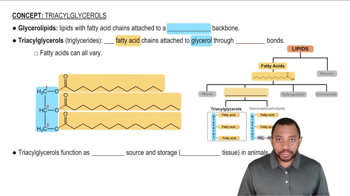
Triacylglycerides

Triacylglycerides, or triglycerides, are the main form of fat stored in the body, composed of three fatty acid molecules esterified to a glycerol backbone. They serve as a major energy source and are found in both dietary fats and body fat. Understanding their structure is essential for grasping how fatty acids are released and utilized.
Video consigliato:
Percorso guidato
1:52
Triacylglycerols Concept 1

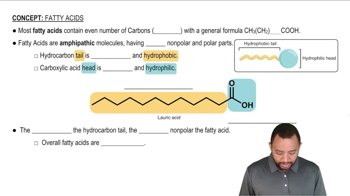
Fatty Acid Release

The release of long-chain fatty acids from triacylglycerides occurs primarily through the action of enzymes called lipases, which hydrolyze the ester bonds. This process is crucial for mobilizing stored fats for energy use, especially during fasting or exercise. The released fatty acids can then enter the bloodstream for transport to various tissues.
Video consigliato:
Percorso guidato
2:00
Fatty Acids Concept 1

Lipid Transport in Bloodstream

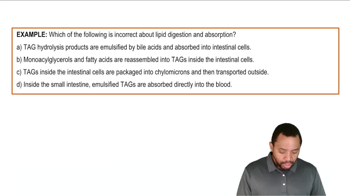
Long-chain fatty acids are not soluble in water, so they require transport proteins to move through the bloodstream. They are typically bound to albumin or incorporated into lipoproteins, such as chylomicrons and very-low-density lipoproteins (VLDL), which facilitate their delivery to tissues for energy production or storage. Understanding this transport mechanism is key to comprehending how fatty acids are utilized by the body.
Video consigliato:
Percorso guidato
1:41
Digestion of Lipids Example 1