Consuming too many carbohydrates causes deposition of fats in adipose tissue. How does this happen?
Ch.24 Lipid Metabolism
McMurry8th EditionFundamentals of General, Organic, and Biological ChemistryISBN: 9780134015187Non è quello che usi tu?Cambia libro di testo
Capitolo 24, Problema 60
How many rounds of the lipogenesis cycle are needed to synthesize stearic acid, C17H35COOH?
Guida verificata passo dopo passo1
Understand the problem: Lipogenesis is the process by which fatty acids are synthesized. Each round of the lipogenesis cycle adds a two-carbon unit to the growing fatty acid chain. Stearic acid (C17H35COOH) is a saturated fatty acid with 18 carbon atoms in total.
Determine the starting molecule: The lipogenesis cycle begins with acetyl-CoA, which contributes two carbons in the first step. Malonyl-CoA is then used in subsequent cycles to add two-carbon units.
Calculate the total number of carbons in stearic acid: Stearic acid has 18 carbons (17 from the hydrocarbon chain and 1 from the carboxylic acid group).
Account for the first two carbons: The first two carbons are provided by acetyl-CoA in the initial step of the cycle. This leaves 16 carbons to be added through subsequent rounds of the cycle.
Divide the remaining carbons by 2: Since each round of the lipogenesis cycle adds two carbons, divide the remaining 16 carbons by 2 to determine the number of additional rounds required. Add 1 for the initial step to get the total number of rounds.

Risposta video verificata per un problema simile:
Questa soluzione video è stata consigliata dai nostri tutor come utile per risolvere questo problema.
Durata del video:
2mConcetti chiave
Ecco i concetti essenziali che devi comprendere per rispondere correttamente alla domanda.
Lipogenesis
Lipogenesis is the metabolic process through which fatty acids are synthesized from acetyl-CoA and other substrates. This process primarily occurs in the liver and adipose tissue and involves a series of enzymatic reactions that convert excess carbohydrates into fatty acids, which can then be stored as triglycerides.
Fatty Acid Synthesis
Fatty acid synthesis involves multiple cycles of the lipogenesis pathway, where each cycle elongates the fatty acid chain by two carbon atoms. The process begins with acetyl-CoA and requires NADPH as a reducing agent, with the final product being a saturated fatty acid, such as stearic acid, which has 18 carbon atoms.
Video consigliato:
Percorso guidato
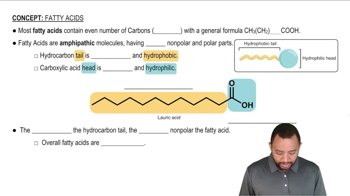
Fatty Acids Concept 1
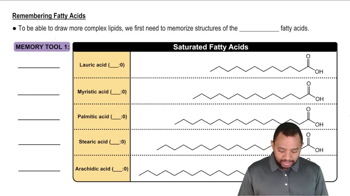
Stearic Acid
Stearic acid is a long-chain saturated fatty acid with the chemical formula C18H36O2. It is produced through the lipogenesis cycle and is important for various biological functions, including energy storage and membrane structure. To synthesize stearic acid, multiple rounds of the lipogenesis cycle are required, specifically 9 cycles, as each cycle adds two carbon atoms to the growing fatty acid chain.
Video consigliato:
Percorso guidato
Fatty Acids Concept 5
Pratica correlata
Domanda del libro di testo
616
views
Domanda del libro di testo
What causes acetone to be present in the breath of someone with uncontrolled diabetes?
1184
views
Domanda del libro di testo
Name the starting material for fatty acid synthesis.
1317
views
Domanda del libro di testo
Why are extra calories consumed as carbohydrates stored as fat and not as glycogen?
1025
views
Domanda del libro di testo
Lipoproteins that transport lipids from the diet are described as exogenous. Those that transport lipids produced in metabolic pathways are described as endogenous. Which of the following lipoproteins transports exogenous lipids and which transports endogenous lipids?
a. Low-density lipoprotein (LDL)
b. Chylomicrons
691
views
Domanda del libro di testo
How many molecules of acetyl-CoA result from complete catabolism of the following compounds?
a. Myristic acid, CH3(CH2)12COOH
538
views