Ch.24 Lipid Metabolism
McMurry - Fundamentals of General, Organic, and Biological Chemistry 8th Edition
McMurry8th EditionFundamentals of General, Organic, and Biological ChemistryISBN: 9780134015187Non è quello che usi tu?Cambia libro di testo
Capitolo 24, Problema 21

What is the purpose of bile acids in lipid digestion?

Guida verificata passo dopo passo
1
Bile acids are amphipathic molecules, meaning they have both hydrophilic (water-attracting) and hydrophobic (water-repelling) regions. This property allows them to interact with both water and lipids.
During lipid digestion, bile acids are secreted by the liver and stored in the gallbladder. When fats enter the small intestine, bile acids are released into the digestive tract.
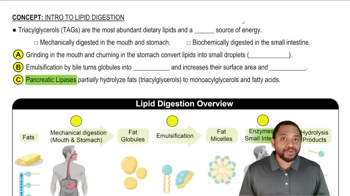
The primary role of bile acids is to emulsify lipids. Emulsification is the process of breaking down large fat globules into smaller droplets, increasing the surface area available for digestive enzymes to act upon.
By emulsifying lipids, bile acids enable the enzyme pancreatic lipase to efficiently hydrolyze triglycerides into free fatty acids and monoglycerides, which are more easily absorbed by the intestinal lining.
Once digestion is complete, bile acids are reabsorbed in the ileum (part of the small intestine) and recycled back to the liver in a process called enterohepatic circulation, ensuring their reuse in future digestion processes.

Risposta video verificata per un problema simile:

Questa soluzione video è stata consigliata dai nostri tutor come utile per risolvere questo problema.
Durata del video:
2m

Concetti chiave

Ecco i concetti essenziali che devi comprendere per rispondere correttamente alla domanda.

Bile Acids

Bile acids are steroid acids derived from cholesterol, produced in the liver and stored in the gallbladder. They play a crucial role in the emulsification of dietary fats, breaking them down into smaller droplets, which increases the surface area for digestive enzymes to act upon. This process is essential for the efficient absorption of lipids in the intestines.
Video consigliato:

Emulsification

Emulsification is the process by which large fat globules are broken down into smaller droplets, allowing for better interaction with digestive enzymes. Bile acids facilitate this process by reducing the surface tension of fat droplets, making it easier for lipases to access and digest the fats. This is a critical step in lipid digestion and absorption.
Video consigliato:
Percorso guidato
2:54
Intro to Lipid Digestion Concept 1

Lipid Absorption

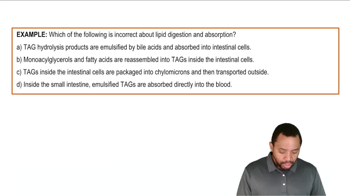
Lipid absorption refers to the process by which digested fats are taken up by the intestinal cells and transported into the bloodstream. After emulsification and enzymatic digestion, the resulting fatty acids and monoglycerides are absorbed through the intestinal lining. This process is vital for providing energy and essential fatty acids to the body.
Video consigliato:
Percorso guidato
1:41
Digestion of Lipids Example 1