Ch.24 Lipid Metabolism
McMurry - Fundamentals of General, Organic, and Biological Chemistry 8th Edition
McMurry8th EditionFundamentals of General, Organic, and Biological ChemistryISBN: 9780134015187Non è quello che usi tu?Cambia libro di testo
Capitolo 24, Problema 48

Write the equation for the final step in the catabolism of any fatty acid with an even number of carbons.

Guida verificata passo dopo passo
1
Identify the process involved: The final step in the catabolism of a fatty acid with an even number of carbons occurs during β-oxidation, where a two-carbon acetyl-CoA molecule is cleaved from the fatty acid chain.
Write the general structure of the fatty acid undergoing β-oxidation: A fatty acyl-CoA molecule with an even number of carbons, represented as CH₃-(CH₂)n-CO-SCoA, where n is an even integer.
Describe the reaction: In the final step of β-oxidation, the fatty acyl-CoA is cleaved by the enzyme thiolase, using a molecule of Coenzyme A (CoA-SH) to produce one acetyl-CoA (CH₃-CO-SCoA) and a shorter fatty acyl-CoA (if applicable).
Write the chemical equation for the reaction: CH₃-(CH₂)n-CO-SCoA + CoA-SH → CH₃-CO-SCoA + CH₃-(CH₂)n-2-CO-SCoA. Note that if n = 2, the reaction produces two acetyl-CoA molecules instead of a shorter fatty acyl-CoA.
Explain the significance: This step is crucial because acetyl-CoA enters the citric acid cycle (Krebs cycle) for further energy production, and the process repeats until the entire fatty acid is converted into acetyl-CoA units.

Risposta video verificata per un problema simile:

Questa soluzione video è stata consigliata dai nostri tutor come utile per risolvere questo problema.
Durata del video:
3m

Concetti chiave

Ecco i concetti essenziali che devi comprendere per rispondere correttamente alla domanda.

Fatty Acid Catabolism

Fatty acid catabolism refers to the metabolic process by which fatty acids are broken down to produce energy. This process primarily occurs in the mitochondria and involves several steps, including activation, beta-oxidation, and the citric acid cycle. The end products of fatty acid catabolism are acetyl-CoA, which can enter the citric acid cycle, and reduced cofactors like NADH and FADH2, which are used in the electron transport chain.
Video consigliato:
Percorso guidato
2:00
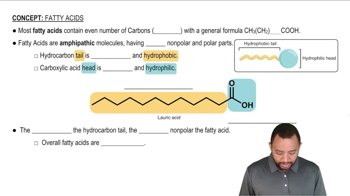
Fatty Acids Concept 1

Beta-Oxidation

Beta-oxidation is the key metabolic pathway for the breakdown of fatty acids. It involves the sequential removal of two-carbon units from the fatty acid chain, converting them into acetyl-CoA. Each cycle of beta-oxidation produces one molecule of acetyl-CoA, along with NADH and FADH2, which are crucial for ATP production in aerobic respiration. This process continues until the entire fatty acid is converted into acetyl-CoA units.
Video consigliato:
Percorso guidato
02:32
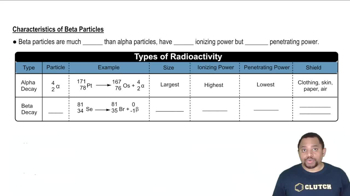
Characteristics of Beta Particles

Final Step of Fatty Acid Catabolism

The final step in the catabolism of an even-numbered fatty acid involves the conversion of the last two-carbon fragment into acetyl-CoA. This occurs after multiple rounds of beta-oxidation, where the fatty acid is progressively shortened. The equation for this final step can be represented as: CnH2nO2 + CoA → n/2 Acetyl-CoA, where 'n' is the number of carbons in the original fatty acid. This acetyl-CoA can then enter the citric acid cycle for further energy production.
Video consigliato:
Percorso guidato
1:06
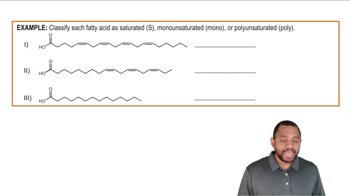
Fatty Acids Example 2