Ch.25 Protein and Amino Acid Metabolism
McMurry - Fundamentals of General, Organic, and Biological Chemistry 8th Edition
McMurry8th EditionFundamentals of General, Organic, and Biological ChemistryISBN: 9780134015187Non è quello che usi tu?Cambia libro di testo
Capitolo 25, Problema 2

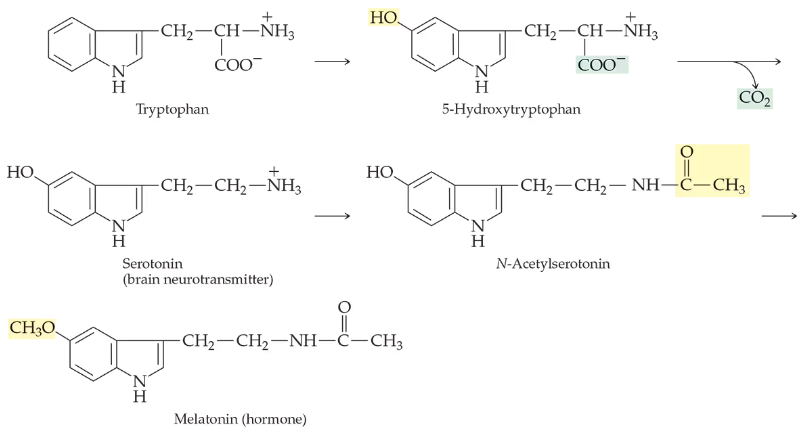
Serotonin is a monoamine neurotransmitter. It is formed in the body from the amino acid tryptophan. What class of enzyme catalyzes each of the two steps that convert tryptophan to serotonin?
Chemical reaction diagram showing the conversion of tryptophan to serotonin and melatonin, highlighting enzyme-catalyzed steps.

Guida verificata passo dopo passo
1
Step 1: Understand the biochemical pathway. The conversion of tryptophan to serotonin involves two enzymatic steps: (1) hydroxylation of tryptophan and (2) decarboxylation of the intermediate product.
Step 2: Identify the enzyme class for the first step. Hydroxylation involves the addition of a hydroxyl (-OH) group to the tryptophan molecule. Enzymes that catalyze hydroxylation reactions are typically classified as oxidoreductases, specifically monooxygenases or hydroxylases.
Step 3: Identify the enzyme class for the second step. Decarboxylation involves the removal of a carboxyl (-COOH) group from the intermediate product. Enzymes that catalyze decarboxylation reactions are classified as lyases, specifically decarboxylases.
Step 4: Relate the enzyme classes to the serotonin synthesis pathway. In the first step, tryptophan hydroxylase (an oxidoreductase) converts tryptophan to 5-hydroxytryptophan. In the second step, aromatic L-amino acid decarboxylase (a lyase) converts 5-hydroxytryptophan to serotonin.
Step 5: Summarize the enzyme classes. The first step is catalyzed by an oxidoreductase (hydroxylase), and the second step is catalyzed by a lyase (decarboxylase). These enzyme classes are essential for the biosynthesis of serotonin from tryptophan.

Risposta video verificata per un problema simile:

Questa soluzione video è stata consigliata dai nostri tutor come utile per risolvere questo problema.
Durata del video:
4m

Concetti chiave

Ecco i concetti essenziali che devi comprendere per rispondere correttamente alla domanda.

Serotonin and its Role

Serotonin is a crucial monoamine neurotransmitter that plays a significant role in regulating mood, sleep, and appetite. It is synthesized in the brain and intestines from the amino acid tryptophan, influencing various physiological functions and behaviors. Understanding serotonin's function is essential for grasping its importance in mental health and neurological disorders.
Video consigliato:
Percorso guidato
1:10
Coenzyme A Example 4

Tryptophan

Tryptophan is an essential amino acid that serves as a precursor for serotonin synthesis. It cannot be produced by the body and must be obtained through diet, found in foods like turkey, nuts, and dairy. The conversion of tryptophan to serotonin involves specific enzymatic reactions, highlighting its importance in neurotransmitter production.
Video consigliato:
Percorso guidato
5:04
Amino Acid Catabolism: Carbon Atoms Concept 3

Enzymatic Catalysis

Enzymatic catalysis refers to the process by which enzymes accelerate biochemical reactions. In the context of serotonin synthesis, two key enzymes are involved: tryptophan hydroxylase, which converts tryptophan to 5-hydroxytryptophan, and aromatic L-amino acid decarboxylase, which further converts 5-hydroxytryptophan to serotonin. Understanding these enzymes is crucial for comprehending the biochemical pathway of serotonin production.
Video consigliato:
Percorso guidato
3:09
Triacylglycerol Reactions: Hydrolysis Concept 1