Ch.26 Nucleic Acids and Protein Synthesis
McMurry - Fundamentals of General, Organic, and Biological Chemistry 8th Edition
McMurry8th EditionFundamentals of General, Organic, and Biological ChemistryISBN: 9780134015187Non è quello che usi tu?Cambia libro di testo
Capitolo 26, Problema 65

What tetrapeptide is synthesized from the informational DNA sequence G-T-C-A-G-T-A-C-G-T-T-A?

Guida verificata passo dopo passo
1
Step 1: Understand the problem. The DNA sequence provided (G-T-C-A-G-T-A-C-G-T-T-A) needs to be translated into a tetrapeptide. This involves determining the mRNA sequence, identifying the codons, and then using the genetic code to find the corresponding amino acids.
Step 2: Transcribe the DNA sequence into mRNA. Replace each DNA base with its complementary RNA base: G (guanine) pairs with C (cytosine), T (thymine) pairs with A (adenine), A (adenine) pairs with U (uracil), and C (cytosine) pairs with G (guanine). The resulting mRNA sequence will be C-A-G-U-C-A-U-G-C-A-A-U.
Step 3: Divide the mRNA sequence into codons. Codons are groups of three nucleotides that correspond to specific amino acids. For the mRNA sequence C-A-G-U-C-A-U-G-C-A-A-U, the codons are CAG, UCA, UGC, and AAU.
Step 4: Use the genetic code to determine the amino acid for each codon. Refer to a codon chart to find the amino acids corresponding to CAG, UCA, UGC, and AAU. Each codon will translate to a specific amino acid.
Step 5: Combine the amino acids in the order determined by the codons to form the tetrapeptide. Write the sequence of the tetrapeptide using the standard three-letter or one-letter abbreviations for the amino acids.

Risposta video verificata per un problema simile:

Questa soluzione video è stata consigliata dai nostri tutor come utile per risolvere questo problema.
Durata del video:
1m

Concetti chiave

Ecco i concetti essenziali che devi comprendere per rispondere correttamente alla domanda.

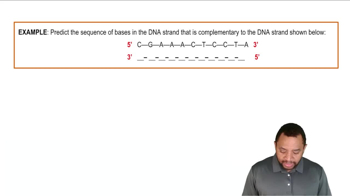
DNA Sequence

A DNA sequence is a series of nucleotides that encode genetic information. Each nucleotide consists of a sugar, a phosphate group, and a nitrogenous base (adenine, thymine, cytosine, or guanine). The specific order of these bases determines the genetic instructions for synthesizing proteins, including peptides.
Video consigliato:
Percorso guidato
1:49
DNA Double Helix Example 1

Transcription and Translation

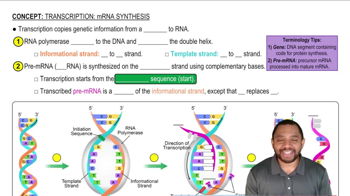
Transcription is the process by which the DNA sequence is copied into messenger RNA (mRNA), which then undergoes translation to synthesize proteins. During translation, ribosomes read the mRNA sequence in sets of three nucleotides (codons), each corresponding to a specific amino acid, ultimately forming a polypeptide chain.
Video consigliato:
Percorso guidato
6:37
Transcription: mRNA Synthesis Concept 1

Tetrapeptide

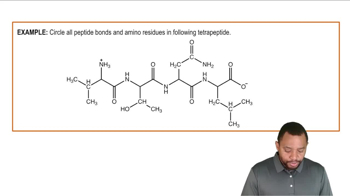
A tetrapeptide is a peptide composed of four amino acids linked by peptide bonds. The sequence of amino acids in a tetrapeptide is determined by the corresponding mRNA codons, which are derived from the original DNA sequence. Understanding how to translate the DNA sequence into a tetrapeptide involves knowing the genetic code that associates specific codons with their respective amino acids.
Video consigliato:
Percorso guidato
1:24
Peptides Example 1