Ch.16 Amino Acids, Proteins, and Enzymes
Timberlake - Chemistry: An Introduction to General, Organic, and Biological Chemistry 13th Edition
Timberlake13th EditionChemistry: An Introduction to General, Organic, and Biological ChemistryISBN: 9780134421353Non è quello che usi tu?Cambia libro di testo
Capitolo 16, Problema 34c

What is the name of the class of enzymes that would catalyze each of the following reactions?
c. splitting peptide bonds in proteins

Guida verificata passo dopo passo
1
Understand the reaction: The problem involves splitting peptide bonds in proteins, which is a type of hydrolysis reaction where water is used to break the bond between amino acids in a protein chain.
Recall the enzyme classification: Enzymes are categorized into six major classes based on the type of reaction they catalyze. Hydrolysis reactions are typically catalyzed by enzymes in the 'hydrolase' class.
Identify the specific type of hydrolase: Enzymes that specifically catalyze the breaking of peptide bonds in proteins are known as 'proteases' or 'peptidases'. These are a subclass of hydrolases.
Consider the mechanism: Proteases work by targeting the peptide bond between amino acids, often using water to cleave the bond and release individual amino acids or smaller peptide fragments.
Conclude the enzyme class: The class of enzymes responsible for splitting peptide bonds in proteins is 'hydrolases', specifically the subclass known as 'proteases' or 'peptidases'.

Risposta video verificata per un problema simile:

Questa soluzione video è stata consigliata dai nostri tutor come utile per risolvere questo problema.
Durata del video:
4m

Concetti chiave

Ecco i concetti essenziali che devi comprendere per rispondere correttamente alla domanda.

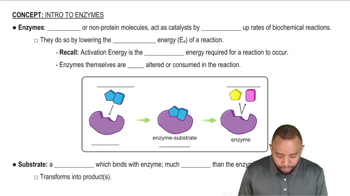
Enzymes

Enzymes are biological catalysts that accelerate chemical reactions in living organisms. They are typically proteins that lower the activation energy required for a reaction to occur, thereby increasing the reaction rate. Each enzyme is specific to a particular substrate and reaction, allowing for precise control of metabolic processes.
Video consigliato:
Percorso guidato
2:14
Intro to Enzymes Concept 1

Peptidases

Peptidases, also known as proteases or proteinases, are a class of enzymes that catalyze the hydrolysis of peptide bonds in proteins. They play a crucial role in various biological processes, including digestion, protein turnover, and cellular signaling. By breaking down proteins into smaller peptides or amino acids, peptidases facilitate nutrient absorption and recycling of amino acids.

Catalysis

Catalysis is the process by which a substance, known as a catalyst, increases the rate of a chemical reaction without being consumed in the process. In biological systems, enzymes serve as catalysts, enabling reactions to occur under mild conditions of temperature and pH. This is essential for sustaining life, as many biochemical reactions would be too slow to support cellular functions without enzymatic catalysis.
Video consigliato:
Percorso guidato
1:17
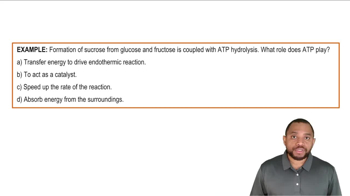
Coupled Reactions Example 3