
Ch.10 Acids and Bases and Equilibrium
Timberlake - Chemistry: An Introduction to General, Organic, and Biological Chemistry 14th Edition
Timberlake14th EditionChemistry: An Introduction to General, Organic, and Biological ChemistryISBN: 9781292472249Non è quello che usi tu?Cambia libro di testo
Capitolo 10, Problema 97a

Calculate the volume, in milliliters, of a 0.150 M NaOH solution that will completely neutralize each of the following:
a. 25.0 mL of a 0.288 M HCl solution

Guida verificata passo dopo passo
1
Step 1: Write the balanced chemical equation for the neutralization reaction. Sodium hydroxide (NaOH) reacts with hydrochloric acid (HCl) in a 1:1 molar ratio: NaOH+HCl→NaCl+H2O.
Step 2: Calculate the moles of HCl in the given solution. Use the formula n=M⋅V, where M is the molarity (0.288 M) and V is the volume in liters (convert 25.0 mL to liters by dividing by 1000).
Step 3: Determine the moles of NaOH required for neutralization. Since the reaction is a 1:1 molar ratio, the moles of NaOH needed will be equal to the moles of HCl calculated in Step 2.
Step 4: Calculate the volume of the NaOH solution required. Use the formula V=nM, where n is the moles of NaOH (from Step 3) and M is the molarity of the NaOH solution (0.150 M).
Step 5: Convert the volume of NaOH from liters to milliliters by multiplying by 1000. This will give the final volume of NaOH solution required to completely neutralize the HCl solution.

Risposta video verificata per un problema simile:

Questa soluzione video è stata consigliata dai nostri tutor come utile per risolvere questo problema.
Durata del video:
2m

Concetti chiave

Ecco i concetti essenziali che devi comprendere per rispondere correttamente alla domanda.

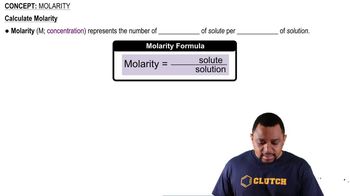
Molarity (M)

Molarity is a measure of concentration defined as the number of moles of solute per liter of solution. It is expressed in moles per liter (mol/L). Understanding molarity is crucial for calculating the amount of reactants needed in a chemical reaction, as it allows for the conversion between volume and moles.
Video consigliato:

Neutralization Reaction

A neutralization reaction occurs when an acid reacts with a base to produce water and a salt. In this context, hydrochloric acid (HCl) reacts with sodium hydroxide (NaOH). The stoichiometry of the reaction, which is typically a 1:1 ratio for strong acids and bases, is essential for determining the volumes required for complete neutralization.
Video consigliato:
Percorso guidato
00:37
Lewis Dot Structures: Neutral Compounds (Simplified) Concept 1

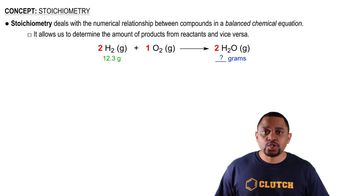
Stoichiometry

Stoichiometry is the calculation of reactants and products in chemical reactions based on the balanced chemical equation. It involves using mole ratios derived from the coefficients of the balanced equation to relate the amounts of different substances. In this problem, stoichiometry will help determine how much NaOH is needed to neutralize the given volume of HCl.
Video consigliato: