Ch.10 Acids and Bases and Equilibrium
Timberlake - Chemistry: An Introduction to General, Organic, and Biological Chemistry 14th Edition
Timberlake14th EditionChemistry: An Introduction to General, Organic, and Biological ChemistryISBN: 9781292472249Non è quello che usi tu?Cambia libro di testo
Capitolo 10, Problema 46a

Complete and balance the equation for each of the following reactions:
c. H2SO4(aq) + Ca(OH)2(s) →

Guida verificata passo dopo passo
1
Identify the type of reaction: This is a neutralization reaction where an acid (H₂SO₄) reacts with a base (Ca(OH)₂) to produce water (H₂O) and a salt.
Write the unbalanced equation: H₂SO₄(aq) + Ca(OH)₂(s) → CaSO₄(s) + H₂O(l). Here, calcium sulfate (CaSO₄) is the salt formed.
Balance the sulfate ion (SO₄²⁻): There is one sulfate ion on both sides of the equation, so no adjustment is needed for this part.
Balance the hydrogen and oxygen atoms: The acid contributes 2 hydrogen atoms, and the base contributes 2 hydroxide ions (OH⁻). These combine to form 2 water molecules. Update the equation to: H₂SO₄(aq) + Ca(OH)₂(s) → CaSO₄(s) + 2H₂O(l).
Verify the balance: Check that the number of each type of atom is the same on both sides of the equation. There are 1 calcium (Ca), 1 sulfate (SO₄²⁻), 2 hydrogen (H), and 2 oxygen (O) atoms on each side, confirming the equation is balanced.

Risposta video verificata per un problema simile:

Questa soluzione video è stata consigliata dai nostri tutor come utile per risolvere questo problema.
Durata del video:
1m

Concetti chiave

Ecco i concetti essenziali che devi comprendere per rispondere correttamente alla domanda.

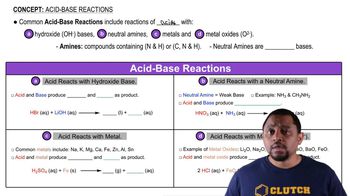
Acid-Base Reactions

Acid-base reactions involve the transfer of protons (H⁺ ions) between reactants. In this case, sulfuric acid (H₂SO₄) acts as an acid, donating protons, while calcium hydroxide (Ca(OH)₂) serves as a base, accepting protons. The reaction typically results in the formation of water and a salt.
Video consigliato:
Percorso guidato
03:08
Acid-Base Reactions Concept 1

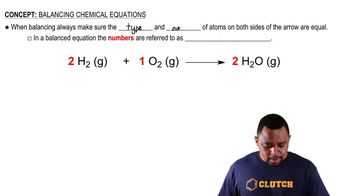
Balancing Chemical Equations

Balancing chemical equations is essential to ensure that the number of atoms of each element is the same on both sides of the equation. This reflects the law of conservation of mass, which states that matter cannot be created or destroyed in a chemical reaction. Each coefficient in the balanced equation indicates the relative number of molecules or moles involved.
Video consigliato:
Percorso guidato
01:32
Balancing Chemical Equations (Simplified) Concept 1

Products of Neutralization

In a neutralization reaction between an acid and a base, the typical products are water and a salt. For the reaction between H₂SO₄ and Ca(OH)₂, the salt formed is calcium sulfate (CaSO₄). Understanding the expected products helps in predicting the outcome of the reaction and in balancing the equation correctly.
Video consigliato:
Percorso guidato
01:37
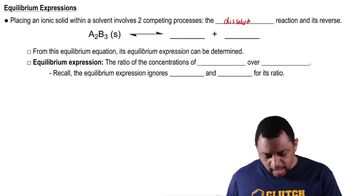
Solubility Product Constant (Ksp) Concept 2