Ch.10 Acids and Bases and Equilibrium
Timberlake - Chemistry: An Introduction to General, Organic, and Biological Chemistry 14th Edition
Timberlake14th EditionChemistry: An Introduction to General, Organic, and Biological ChemistryISBN: 9781292472249Non è quello che usi tu?Cambia libro di testo
Capitolo 10, Problema 1a

Indicate whether each of the following statements is characteristic of an acid, a base, or both
c. produces H⁺ ions in water

Guida verificata passo dopo passo
1
Understand the definition of an acid: Acids are substances that increase the concentration of hydrogen ions (H⁺) when dissolved in water. This is a key characteristic of acids according to the Arrhenius definition.
Recall the definition of a base: Bases are substances that increase the concentration of hydroxide ions (OH⁻) when dissolved in water. Bases do not produce H⁺ ions in water.
Compare the given statement to the definitions: The statement mentions the production of H⁺ ions in water, which aligns with the definition of an acid.
Conclude that the characteristic described in the statement is specific to acids and not bases, as bases do not produce H⁺ ions in water.
State the final classification: The statement 'produces H⁺ ions in water' is characteristic of an acid.

Risposta video verificata per un problema simile:

Questa soluzione video è stata consigliata dai nostri tutor come utile per risolvere questo problema.
Durata del video:
1m

Concetti chiave

Ecco i concetti essenziali che devi comprendere per rispondere correttamente alla domanda.

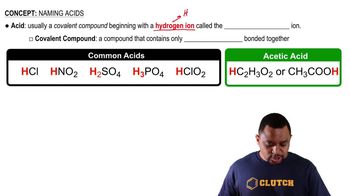
Acids

Acids are substances that, when dissolved in water, increase the concentration of hydrogen ions (H⁺). This characteristic is fundamental to their definition, as acids typically have a sour taste and can react with bases to form salts and water. Common examples include hydrochloric acid (HCl) and sulfuric acid (H₂SO₄).
Video consigliato:

Bases

Bases are substances that, when dissolved in water, produce hydroxide ions (OH⁻) or can accept hydrogen ions (H⁺). They are often characterized by a bitter taste and slippery feel. Common examples include sodium hydroxide (NaOH) and ammonia (NH₃). Bases can neutralize acids, forming water and salts.
Video consigliato:
Percorso guidato
1:23
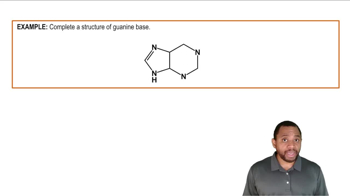
Nitrogenous Bases Example 3

pH Scale

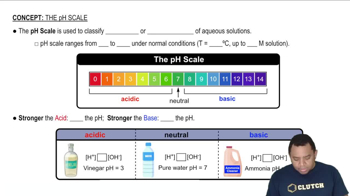
The pH scale measures the acidity or basicity of a solution, ranging from 0 to 14. A pH less than 7 indicates an acidic solution, while a pH greater than 7 indicates a basic solution. A pH of 7 is considered neutral, as seen in pure water. Understanding the pH scale is essential for determining the nature of a substance in aqueous solutions.
Video consigliato: