Someone with severe diabetes obtains energy by the breakdown of fats, which produce large amounts of acidic substances. How would this affect the pH of the blood plasma?
Ch.10 Acids and Bases and Equilibrium
Timberlake14th EditionChemistry: An Introduction to General, Organic, and Biological ChemistryISBN: 9781292472249Non è quello che usi tu?Cambia libro di testo
Capitolo 10, Problema 56
Which of the following represents a buffer system? Explain.
a. H3PO3
b. NaNO3
c. HC2H3O2 and NaC2H3O2
d. HCl and NaOH
Guida verificata passo dopo passo1
Understand the concept of a buffer system: A buffer system is a solution that resists changes in pH when small amounts of acid or base are added. It typically consists of a weak acid and its conjugate base, or a weak base and its conjugate acid.
Analyze option a (H₃PO₃): H₃PO₃ is a weak acid, but it is not paired with its conjugate base. Therefore, it does not form a buffer system.
Analyze option b (NaNO₃): NaNO₃ is a salt of a strong acid (HNO₃) and a strong base (NaOH). It does not contain a weak acid or weak base, so it cannot act as a buffer system.
Analyze option c (HC₂H₃O₂ and NaC₂H₃O₂): HC₂H₃O₂ (acetic acid) is a weak acid, and NaC₂H₃O₂ (sodium acetate) is its conjugate base. Together, they form a buffer system because they can resist changes in pH by neutralizing added acids or bases.
Analyze option d (HCl and NaOH): HCl is a strong acid, and NaOH is a strong base. A strong acid and strong base do not form a buffer system because they completely dissociate in water and do not provide the weak acid/conjugate base pair needed for buffering.

Risposta video verificata per un problema simile:
Questa soluzione video è stata consigliata dai nostri tutor come utile per risolvere questo problema.
Durata del video:
5mConcetti chiave
Ecco i concetti essenziali che devi comprendere per rispondere correttamente alla domanda.
Buffer System
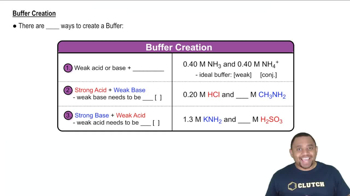
A buffer system is a solution that resists changes in pH when small amounts of acid or base are added. It typically consists of a weak acid and its conjugate base or a weak base and its conjugate acid. This equilibrium allows the buffer to neutralize added acids or bases, maintaining a relatively stable pH.
Video consigliato:
Percorso guidato
Buffer Creation Methods
Weak Acid and Conjugate Base
A weak acid is an acid that partially dissociates in solution, meaning it does not completely ionize. Its conjugate base is formed when the weak acid donates a proton (H⁺). Together, they can effectively moderate pH changes, making them essential components of buffer systems.
Video consigliato:
Percorso guidato
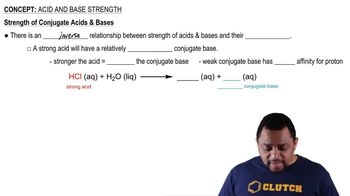
Acid and Base Strength Concept 3
Strong Acid and Strong Base
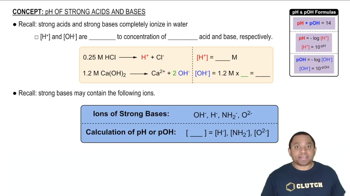
Strong acids, like HCl, and strong bases, like NaOH, completely dissociate in solution, leading to significant changes in pH. Unlike buffer systems, they do not have the capacity to resist pH changes when acids or bases are added, as they do not establish an equilibrium with a weak counterpart.
Video consigliato:
Percorso guidato
Strong Acids and Bases
Pratica correlata
Domanda del libro di testo
815
views
Domanda del libro di testo
When food enters the stomach, HCl is released and the [H3O+] of the stomach fluid rises to 4 × 10⁻² M. What is the pH of the stomach fluid?
997
views
Domanda del libro di testo
Write the balanced chemical equation for the neutralization reaction of stomach acid HCl with Al(OH)3, an ingredient in some antacids.
1084
views
Domanda del libro di testo
If 32.8 mL of a 0.162 M NaOH solution is required to titrate 25.0 mL of a solution of H2SO4, what is the molarity of the H2SO4 solution?
H2SO4(aq) + 2 KOH(aq) → 2 H2O(l) + K2SO4(aq)
1446
views
Domanda del libro di testo
Write a balanced equation for the neutralization of each of the following:
c. HNO3(aq) and Mg(OH)2(s)
997
views
Domanda del libro di testo
Balance each of the following neutralization equations:
a. HNO3(aq) + Ba(OH)2(s) → H2O(l) + Ba(NO3)2(aq)
1921
views