Ch.10 Acids and Bases and Equilibrium
Timberlake - Chemistry: An Introduction to General, Organic, and Biological Chemistry 14th Edition
Timberlake14th EditionChemistry: An Introduction to General, Organic, and Biological ChemistryISBN: 9781292472249Non è quello che usi tu?Cambia libro di testo
Capitolo 10, Problema 9c

Write the formula for the conjugate base for each of the following acids:
b. H2O

Guida verificata passo dopo passo
1
Identify the definition of a conjugate base: A conjugate base is formed when an acid donates a proton (H⁺). This means the acid loses one hydrogen ion, resulting in a species with one less hydrogen and a charge that is more negative by 1.
Start with the given acid, H₂O (water). Recognize that H₂O can act as an acid by donating one proton (H⁺).
Remove one hydrogen ion (H⁺) from H₂O. This leaves behind the hydroxide ion, OH⁻.
Determine the charge of the resulting species: Since a neutral H₂O molecule loses a positively charged H⁺ ion, the resulting species, OH⁻, will have a negative charge.
Write the formula for the conjugate base of H₂O: The conjugate base is OH⁻.

Risposta video verificata per un problema simile:

Questa soluzione video è stata consigliata dai nostri tutor come utile per risolvere questo problema.
Durata del video:
2m

Concetti chiave

Ecco i concetti essenziali che devi comprendere per rispondere correttamente alla domanda.

Conjugate Base

A conjugate base is the species that remains after an acid donates a proton (H⁺) during a chemical reaction. It is formed when an acid loses a hydrogen ion, and it can potentially accept a proton in a subsequent reaction. Understanding conjugate bases is essential for grasping acid-base chemistry and the concept of equilibrium in reactions.
Video consigliato:
Percorso guidato
00:50
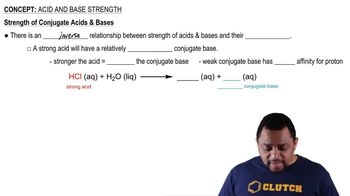
Acid and Base Strength Concept 3

Acid-Base Theory

Acid-base theory encompasses various models that define acids and bases, including the Brønsted-Lowry theory, which defines acids as proton donors and bases as proton acceptors. This theory is fundamental for predicting the behavior of substances in chemical reactions, particularly in aqueous solutions where water often acts as both an acid and a base.
Video consigliato:

Water as an Acid and Base

Water (H₂O) can act as both an acid and a base, making it amphoteric. When it donates a proton, it forms the hydroxide ion (OH⁻), which is its conjugate base. This dual behavior is crucial in many chemical reactions and helps explain the role of water in acid-base equilibria and the pH scale.
Video consigliato:
Percorso guidato
00:50
Acid and Base Strength Concept 3