Ch.11 Introduction to Organic Chemistry: Hydrocarbons
Timberlake - Chemistry: An Introduction to General, Organic, and Biological Chemistry 14th Edition
Timberlake14th EditionChemistry: An Introduction to General, Organic, and Biological ChemistryISBN: 9781292472249Non è quello che usi tu?Cambia libro di testo
Capitolo 11, Problema 42d

Match the following physical and chemical properties with octane, C8H18 found in gasoline, or magnesium sulfate, MgSO4 also called Epsom salts:
d. is a liquid at room temperature

Guida verificata passo dopo passo
1
Identify the two substances in the problem: octane (C₈H₁₈) and magnesium sulfate (MgSO₄). Octane is a hydrocarbon commonly found in gasoline, while magnesium sulfate is an ionic compound often used as Epsom salts.
Understand the physical state of each substance at room temperature (approximately 25°C): Octane is a liquid because it is a nonpolar hydrocarbon with relatively low intermolecular forces (London dispersion forces). Magnesium sulfate, on the other hand, is a solid at room temperature due to its ionic lattice structure.
Recall that the problem asks which substance is a liquid at room temperature. Based on the information above, octane (C₈H₁₈) is the liquid at room temperature.
Relate this property to the molecular structure: Octane's nonpolar nature and relatively low molecular weight allow it to exist as a liquid under standard conditions, while magnesium sulfate's ionic bonds result in a solid crystalline structure.
Conclude that the correct match for the property 'is a liquid at room temperature' is octane (C₈H₁₈).

Risposta video verificata per un problema simile:

Questa soluzione video è stata consigliata dai nostri tutor come utile per risolvere questo problema.

Concetti chiave

Ecco i concetti essenziali che devi comprendere per rispondere correttamente alla domanda.

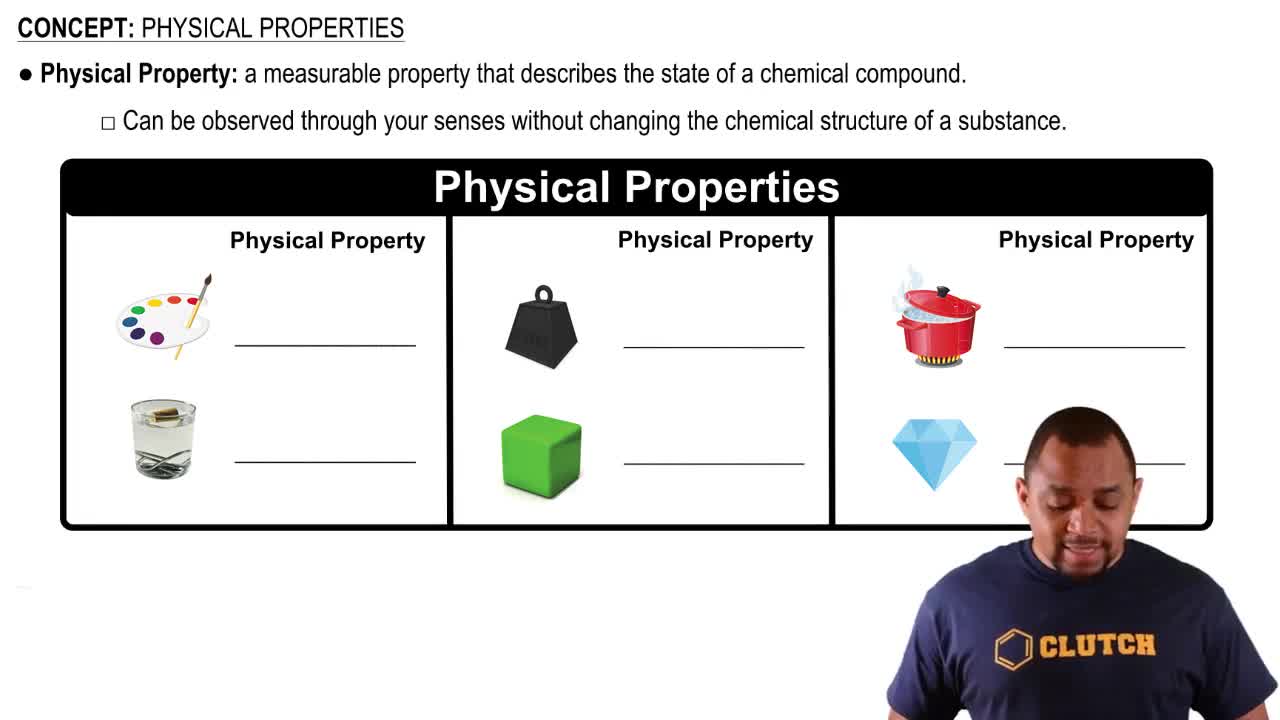
Physical Properties

Physical properties are characteristics of a substance that can be observed or measured without changing its chemical identity. Examples include state (solid, liquid, gas), color, melting point, and boiling point. Understanding these properties helps in identifying substances and predicting their behavior under different conditions.
Video consigliato:
Percorso guidato
02:54
Physical Properties Concept

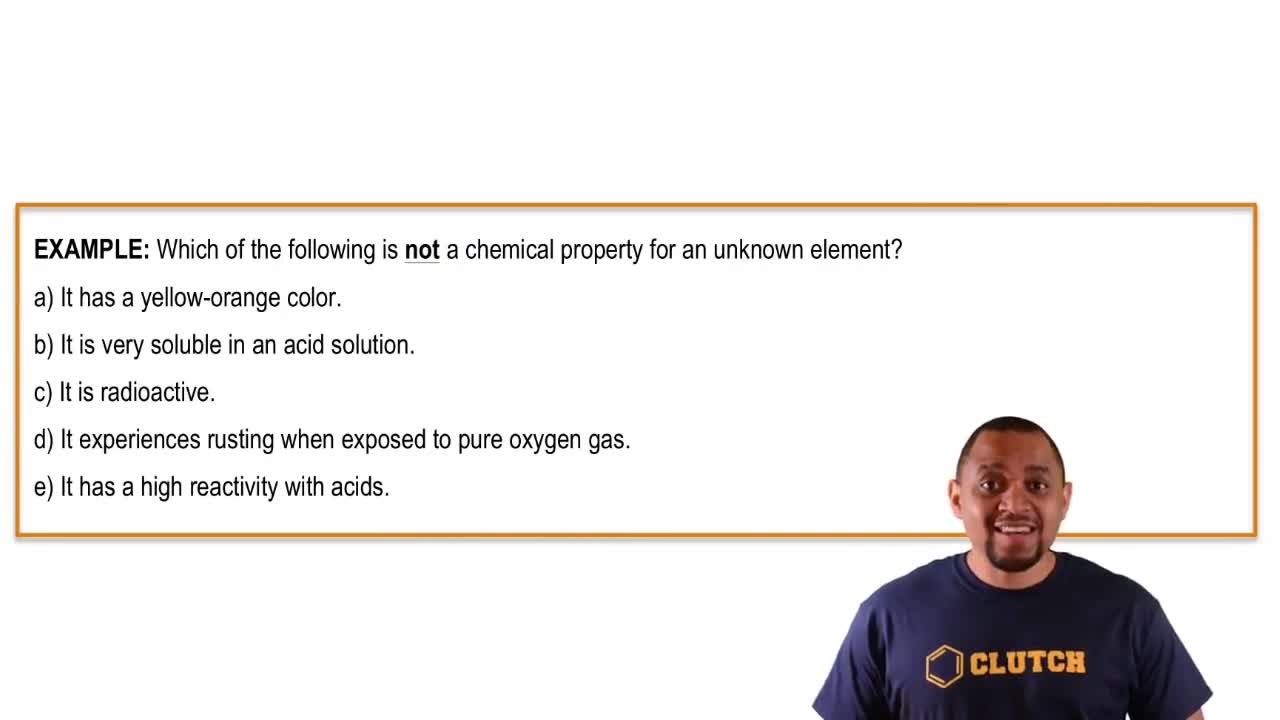
Chemical Properties

Chemical properties describe how a substance interacts with other substances, leading to a change in its chemical composition. These properties include reactivity, acidity, and flammability. Recognizing chemical properties is essential for understanding how substances will behave in chemical reactions.
Video consigliato:
Percorso guidato
02:11
Chemical Properties Example 1

State of Matter

The state of matter refers to the distinct forms that different phases of matter take on, primarily solid, liquid, and gas. The state is determined by temperature and pressure conditions. For instance, octane is a liquid at room temperature, while magnesium sulfate typically exists as a solid or in hydrated forms, illustrating the importance of state in classifying substances.
Video consigliato:
Percorso guidato
01:35
States of Matter Concept 1