Ch.15 Lipids
Timberlake - Chemistry: An Introduction to General, Organic, and Biological Chemistry 14th Edition
Timberlake14th EditionChemistry: An Introduction to General, Organic, and Biological ChemistryISBN: 9781292472249Non è quello che usi tu?Cambia libro di testo
Capitolo 15, Problema 43

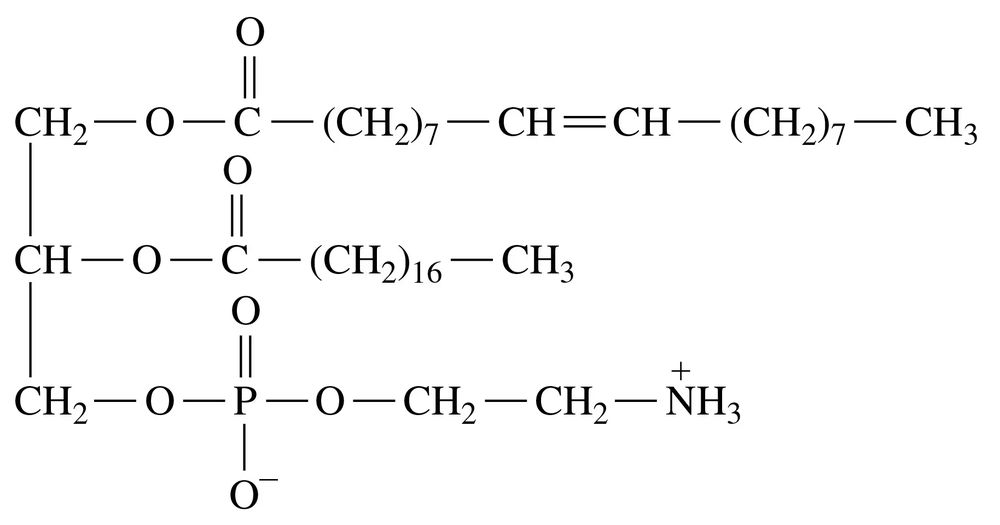
Identify the following glycerophospholipid, which is found in the nerves and spinal cord in the body, as a lecithin or cephalin, and list its components: 
Chemical structure of a glycerophospholipid, indicating its components and functional groups.

Guida verificata passo dopo passo
1
Examine the structure of the glycerophospholipid in the image provided. Look for the functional groups attached to the glycerol backbone, as these will help identify whether it is a lecithin or cephalin.
Recall that lecithins (phosphatidylcholines) contain a choline group attached to the phosphate, while cephalins (phosphatidylethanolamines) contain an ethanolamine group. Identify the group attached to the phosphate in the structure.
Break down the glycerophospholipid into its components. These typically include: (1) a glycerol backbone, (2) two fatty acid chains, (3) a phosphate group, and (4) the specific group attached to the phosphate (choline or ethanolamine).
List the fatty acid chains by identifying the hydrocarbon chains attached to the glycerol backbone. Note their length and whether they are saturated or unsaturated.
Summarize the identification of the glycerophospholipid (lecithin or cephalin) and its components, including the glycerol backbone, fatty acid chains, phosphate group, and the specific group attached to the phosphate.

Risposta video verificata per un problema simile:

Questa soluzione video è stata consigliata dai nostri tutor come utile per risolvere questo problema.
Durata del video:
5m

Concetti chiave

Ecco i concetti essenziali che devi comprendere per rispondere correttamente alla domanda.

Glycerophospholipids

Glycerophospholipids are a class of lipids that are a major component of cell membranes. They consist of a glycerol backbone, two fatty acid tails, and a phosphate group, which can be further modified by various head groups. These lipids play crucial roles in membrane structure, signaling, and cellular interactions.
Video consigliato:
Percorso guidato
1:09
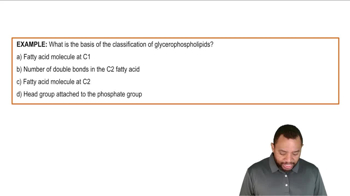
Glycerophospholipids Example 2

Lecithin vs. Cephalin

Lecithin and cephalin are types of glycerophospholipids distinguished by their head groups. Lecithin, or phosphatidylcholine, contains choline as its head group and is abundant in egg yolk and soybeans. Cephalin, or phosphatidylethanolamine, contains ethanolamine and is primarily found in the brain and nervous tissues, playing a role in cell membrane integrity.
Video consigliato:
Percorso guidato
3:33
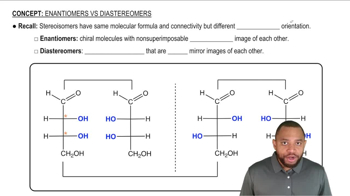
Enantiomers vs Diastereomers Concept 1

Components of Glycerophospholipids

The primary components of glycerophospholipids include a glycerol backbone, two fatty acid chains, and a phosphate group. The fatty acids can vary in length and saturation, affecting the fluidity of the membrane. The phosphate group can be linked to different alcohols, such as choline or ethanolamine, which define whether the lipid is classified as lecithin or cephalin.
Video consigliato:
Percorso guidato
1:09
Glycerophospholipids Example 2