Ch.16 Amino Acids, Proteins, and Enzymes
Timberlake - Chemistry: An Introduction to General, Organic, and Biological Chemistry 14th Edition
Timberlake14th EditionChemistry: An Introduction to General, Organic, and Biological ChemistryISBN: 9781292472249Non è quello che usi tu?Cambia libro di testo
Capitolo 16, Problema 37b

How is the active site different from the whole enzyme structure?

Guida verificata passo dopo passo
1
Understand the concept of an enzyme: Enzymes are biological catalysts made up of proteins that speed up chemical reactions in living organisms. They have a specific three-dimensional structure that determines their function.
Define the active site: The active site is a small, specific region within the enzyme where the substrate binds and the chemical reaction occurs. It is typically a pocket or groove on the enzyme's surface.
Compare the active site to the whole enzyme structure: While the active site is a small part of the enzyme, the entire enzyme structure includes all the amino acid chains folded into a unique shape. This overall structure supports the active site and ensures the enzyme's stability and functionality.
Explain the role of the active site: The active site is responsible for the enzyme's specificity and catalytic activity. It interacts with the substrate through non-covalent interactions such as hydrogen bonds, ionic bonds, and van der Waals forces.
Highlight the importance of the enzyme's structure: The enzyme's overall structure ensures the active site is properly positioned and shaped to bind the substrate effectively. Any changes to the enzyme's structure, such as denaturation, can disrupt the active site and impair enzyme function.

Risposta video verificata per un problema simile:

Questa soluzione video è stata consigliata dai nostri tutor come utile per risolvere questo problema.
Durata del video:
3m

Concetti chiave

Ecco i concetti essenziali che devi comprendere per rispondere correttamente alla domanda.

Active Site

The active site is a specific region on an enzyme where substrate molecules bind and undergo a chemical reaction. It is typically a small pocket or groove on the enzyme's surface, formed by the unique arrangement of amino acids. The shape and chemical environment of the active site are crucial for its ability to catalyze reactions, as they determine the specificity and efficiency of the enzyme.
Video consigliato:
Percorso guidato
1:06
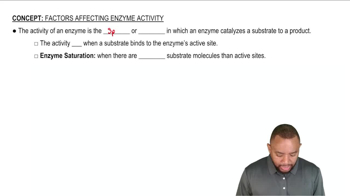
Factors Affecting Enzyme Activity Concept 1

Enzyme Structure

The overall structure of an enzyme refers to its three-dimensional shape, which is determined by the sequence of amino acids and the folding patterns that arise from interactions such as hydrogen bonds, ionic bonds, and hydrophobic interactions. This structure includes not only the active site but also other regions that contribute to the enzyme's stability and functionality. The complete enzyme structure is essential for maintaining the integrity and proper functioning of the active site.
Video consigliato:
Percorso guidato
2:14
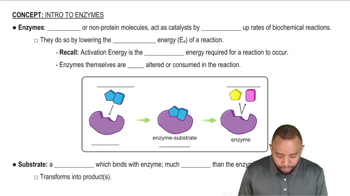
Intro to Enzymes Concept 1

Enzyme-Substrate Specificity

Enzyme-substrate specificity refers to the ability of an enzyme to selectively bind to a particular substrate, which is determined by the complementary shapes and chemical properties of the active site and the substrate. This specificity is often described by the 'lock and key' model or the 'induced fit' model, where the active site adjusts to fit the substrate upon binding. Understanding this concept is vital for grasping how enzymes catalyze specific biochemical reactions.
Video consigliato:
Percorso guidato
2:32
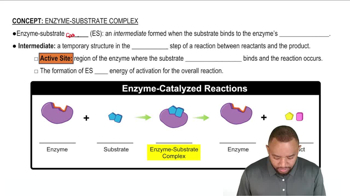
Enzyme-Substrate Complex Concept 1