Ch.16 Amino Acids, Proteins, and Enzymes
Timberlake - Chemistry: An Introduction to General, Organic, and Biological Chemistry 14th Edition
Timberlake14th EditionChemistry: An Introduction to General, Organic, and Biological ChemistryISBN: 9781292472249Non è quello che usi tu?Cambia libro di testo
Capitolo 16, Problema 65d

What are some differences between each of the following pairs?
d. dipeptides and tripeptides

Guida verificata passo dopo passo
1
Understand the terms: A dipeptide is a molecule composed of two amino acids linked by a single peptide bond, while a tripeptide consists of three amino acids linked by two peptide bonds.
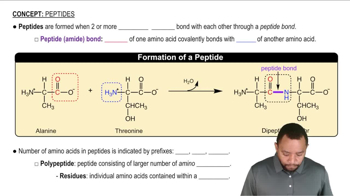
Recall the structure of amino acids: Amino acids are the building blocks of peptides and proteins, and they are linked together through peptide bonds formed by a dehydration reaction between the carboxyl group of one amino acid and the amino group of another.
Identify the key difference: The primary difference between dipeptides and tripeptides is the number of amino acids and peptide bonds. Dipeptides have two amino acids and one peptide bond, while tripeptides have three amino acids and two peptide bonds.
Consider the molecular weight: Tripeptides will have a higher molecular weight than dipeptides because they contain an additional amino acid.
Think about their biological roles: Both dipeptides and tripeptides can have distinct biological functions, but tripeptides may have more complex roles due to their additional amino acid, which can influence their structure and activity.

Risposta video verificata per un problema simile:

Questa soluzione video è stata consigliata dai nostri tutor come utile per risolvere questo problema.
Durata del video:
1m

Concetti chiave

Ecco i concetti essenziali che devi comprendere per rispondere correttamente alla domanda.

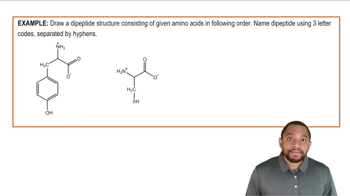
Dipeptides

Dipeptides are molecules formed by the linkage of two amino acids through a peptide bond. This bond occurs when the carboxyl group of one amino acid reacts with the amino group of another, releasing a molecule of water in a condensation reaction. Dipeptides play a role in protein synthesis and can influence various biological functions.
Video consigliato:
Percorso guidato
2:27
Peptides Example 2

Tripeptides

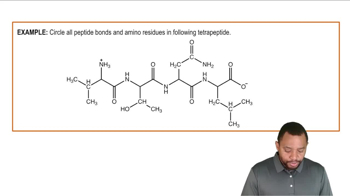
Tripeptides consist of three amino acids connected by two peptide bonds. Similar to dipeptides, the formation of tripeptides involves the condensation of the amino and carboxyl groups of adjacent amino acids. Tripeptides can serve as signaling molecules and may have specific biological activities, often acting as precursors to larger proteins.
Video consigliato:
Percorso guidato
3:07
Peptides Concept 1

Peptide Bonds

Peptide bonds are the covalent bonds that link amino acids together in proteins and peptides. They are formed through a dehydration synthesis reaction, where the carboxyl group of one amino acid reacts with the amino group of another. The nature of peptide bonds influences the structure and function of proteins, as the sequence and number of amino acids determine the properties of the resulting peptide.
Video consigliato:
Percorso guidato
1:24
Peptides Example 1