Ch.16 Amino Acids, Proteins, and Enzymes
Timberlake - Chemistry: An Introduction to General, Organic, and Biological Chemistry 14th Edition
Timberlake14th EditionChemistry: An Introduction to General, Organic, and Biological ChemistryISBN: 9781292472249Non è quello che usi tu?Cambia libro di testo
Capitolo 16, Problema 21c

What type of interaction would you expect between the R groups of the following amino acids in a tertiary structure?
c. serine and aspartate

Guida verificata passo dopo passo
1
Identify the R groups of the amino acids: Serine has a hydroxyl (-OH) group in its side chain, making it polar, while aspartate has a carboxylate (-COO⁻) group, which is negatively charged and also polar.
Understand the nature of the interaction: Polar groups can interact through hydrogen bonding or ionic interactions. In this case, the hydroxyl group of serine can act as a hydrogen bond donor or acceptor, and the carboxylate group of aspartate can act as a hydrogen bond acceptor.
Determine the specific interaction: The hydroxyl group of serine can form a hydrogen bond with the negatively charged carboxylate group of aspartate. This is a hydrogen bonding interaction.
Consider the context of tertiary structure: In the folded protein, these interactions help stabilize the three-dimensional structure by bringing the side chains of serine and aspartate into close proximity.
Conclude the type of interaction: The interaction between the R groups of serine and aspartate in a tertiary structure is primarily a hydrogen bond, facilitated by the polar nature of their side chains.

Risposta video verificata per un problema simile:

Questa soluzione video è stata consigliata dai nostri tutor come utile per risolvere questo problema.
Durata del video:
4m

Concetti chiave

Ecco i concetti essenziali che devi comprendere per rispondere correttamente alla domanda.

Amino Acid R Groups

Amino acids have unique side chains known as R groups, which determine their chemical properties and interactions. These R groups can be polar, nonpolar, acidic, or basic, influencing how amino acids interact with each other in a protein's tertiary structure. Understanding the nature of these R groups is essential for predicting interactions in protein folding.
Video consigliato:
Percorso guidato
2:21
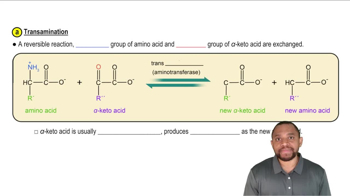
Amino Acid Catabolism: Amino Group Concept 2

Hydrogen Bonding

Hydrogen bonding is a type of weak interaction that occurs when a hydrogen atom covalently bonded to an electronegative atom, like oxygen or nitrogen, is attracted to another electronegative atom. In the context of serine and aspartate, the hydroxyl group of serine can form hydrogen bonds with the carboxyl group of aspartate, stabilizing the tertiary structure of proteins.
Video consigliato:
Percorso guidato
1:22
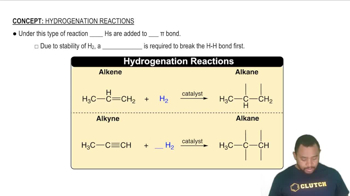
Hydrogenation Reactions Concept 1

Ionic Interactions

Ionic interactions occur between charged R groups of amino acids, such as the negatively charged aspartate and the positively charged groups of other amino acids. These interactions can significantly influence protein structure and stability, as they help to hold the tertiary structure together by attracting oppositely charged groups.
Video consigliato:
Percorso guidato
02:33
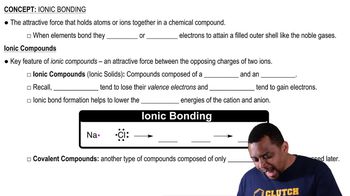
Ionic Bonding Concept 1