Ch.17 Nucleic Acids and Protein Synthesis
Timberlake - Chemistry: An Introduction to General, Organic, and Biological Chemistry 14th Edition
Timberlake14th EditionChemistry: An Introduction to General, Organic, and Biological ChemistryISBN: 9781292472249Non è quello che usi tu?Cambia libro di testo
Capitolo 17, Problema 33

What are the three different types of RNA?

Guida verificata passo dopo passo
1
Understand that RNA (ribonucleic acid) is a molecule essential for various biological roles, particularly in the synthesis of proteins.
Learn that there are three main types of RNA, each with a specific function in the process of protein synthesis.
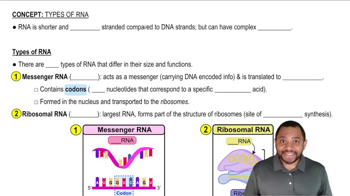
The first type is messenger RNA (mRNA), which carries the genetic information from DNA to the ribosome, where proteins are synthesized.
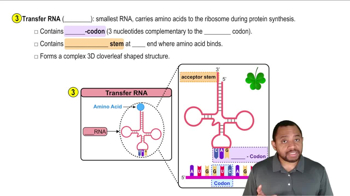
The second type is transfer RNA (tRNA), which helps decode the mRNA sequence into a protein by bringing the appropriate amino acids to the ribosome during translation.
The third type is ribosomal RNA (rRNA), which is a structural component of ribosomes and plays a critical role in catalyzing the formation of peptide bonds between amino acids.

Risposta video verificata per un problema simile:

Questa soluzione video è stata consigliata dai nostri tutor come utile per risolvere questo problema.
Durata del video:
2m

Concetti chiave

Ecco i concetti essenziali che devi comprendere per rispondere correttamente alla domanda.

Messenger RNA (mRNA)

Messenger RNA (mRNA) is a type of RNA that carries genetic information from DNA to the ribosome, where proteins are synthesized. It serves as a template for translation, ensuring that the correct amino acids are assembled in the proper order to form proteins. mRNA is synthesized during transcription and undergoes processing before it can be translated.
Video consigliato:
Percorso guidato
2:43
Types of RNA Concept 1

Transfer RNA (tRNA)

Transfer RNA (tRNA) is responsible for bringing the appropriate amino acids to the ribosome during protein synthesis. Each tRNA molecule has an anticodon that pairs with a corresponding codon on the mRNA, ensuring that the correct amino acid is added to the growing polypeptide chain. This process is crucial for translating the genetic code into functional proteins.
Video consigliato:
Percorso guidato
2:23
Types of RNA Concept 2

Ribosomal RNA (rRNA)

Ribosomal RNA (rRNA) is a structural and functional component of ribosomes, the cellular machinery that synthesizes proteins. rRNA helps to catalyze the formation of peptide bonds between amino acids and ensures the proper alignment of mRNA and tRNA during translation. It plays a vital role in the overall process of protein synthesis, making it essential for cellular function.
Video consigliato:
Percorso guidato
2:43
Types of RNA Concept 1