Ch.17 Nucleic Acids and Protein Synthesis
Timberlake - Chemistry: An Introduction to General, Organic, and Biological Chemistry 14th Edition
Timberlake14th EditionChemistry: An Introduction to General, Organic, and Biological ChemistryISBN: 9781292472249Non è quello che usi tu?Cambia libro di testo
Capitolo 17, Problema 101

What is similar about the primary structure of RNA and DNA?

Guida verificata passo dopo passo
1
Understand the concept of primary structure: The primary structure of nucleic acids refers to the sequence of nucleotides linked together by phosphodiester bonds. Both RNA and DNA have a specific sequence of nucleotides that determines their function.
Identify the components of nucleotides: Both RNA and DNA are composed of nucleotides, which consist of three parts: a phosphate group, a sugar molecule, and a nitrogenous base.
Compare the sugar molecules: In DNA, the sugar is deoxyribose, while in RNA, the sugar is ribose. Despite this difference, both sugars form the backbone of the nucleic acid structure.
Examine the nitrogenous bases: Both RNA and DNA use adenine (A), cytosine (C), and guanine (G) as nitrogenous bases. DNA uses thymine (T), while RNA uses uracil (U) instead of thymine.
Highlight the similarity in the backbone structure: Both RNA and DNA have a backbone made of alternating sugar and phosphate groups connected by phosphodiester bonds, which provides structural stability and directionality to the molecule.

Risposta video verificata per un problema simile:

Questa soluzione video è stata consigliata dai nostri tutor come utile per risolvere questo problema.
Durata del video:
2m

Concetti chiave

Ecco i concetti essenziali che devi comprendere per rispondere correttamente alla domanda.

Nucleic Acids

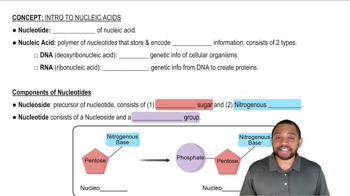
Nucleic acids, including DNA (deoxyribonucleic acid) and RNA (ribonucleic acid), are biopolymers essential for all known forms of life. They are composed of long chains of nucleotides, which are the building blocks that store and transmit genetic information. Understanding the structure of these molecules is crucial for grasping their functions in biological processes.
Video consigliato:
Percorso guidato
1:55
Intro to Nucleic Acids Concept 1

Primary Structure

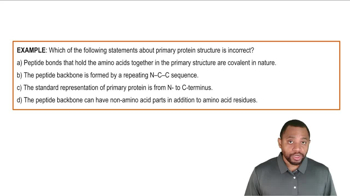
The primary structure of nucleic acids refers to the linear sequence of nucleotides in a strand. This sequence determines the genetic information carried by the molecule. Both RNA and DNA have a primary structure that consists of a sugar-phosphate backbone with nitrogenous bases attached, which is fundamental to their roles in encoding and expressing genetic information.
Video consigliato:
Percorso guidato
1:11
Primary Protein Structure Example 1

Base Pairing

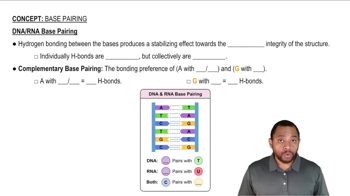
Base pairing is a key concept in nucleic acid structure, referring to the specific hydrogen bonding between nitrogenous bases. In DNA, adenine pairs with thymine, and cytosine pairs with guanine, while in RNA, adenine pairs with uracil instead of thymine. This complementary base pairing is essential for the stability of the double helix in DNA and the various structures formed by RNA.
Video consigliato:
Percorso guidato
2:56
Base Pairing Concept 1