Ch.17 Nucleic Acids and Protein Synthesis
Timberlake - Chemistry: An Introduction to General, Organic, and Biological Chemistry 14th Edition
Timberlake14th EditionChemistry: An Introduction to General, Organic, and Biological ChemistryISBN: 9781292472249Non è quello che usi tu?Cambia libro di testo
Capitolo 17, Problema 47

What is the difference between a codon and an anticodon?

Guida verificata passo dopo passo
1
A codon is a sequence of three nucleotides on messenger RNA (mRNA) that specifies a particular amino acid or a stop signal during protein synthesis. It is part of the genetic code.
An anticodon is a sequence of three nucleotides on transfer RNA (tRNA) that is complementary to a specific codon on the mRNA. It helps ensure the correct amino acid is added to the growing polypeptide chain.
The codon and anticodon pair through complementary base pairing: adenine (A) pairs with uracil (U), and cytosine (C) pairs with guanine (G).
The codon is located on the mRNA strand, which is read during translation, while the anticodon is part of the tRNA molecule that carries the corresponding amino acid.
In summary, the codon provides the genetic instructions, and the anticodon ensures the correct amino acid is delivered to the ribosome during protein synthesis.

Risposta video verificata per un problema simile:

Questa soluzione video è stata consigliata dai nostri tutor come utile per risolvere questo problema.
Durata del video:
3m

Concetti chiave

Ecco i concetti essenziali che devi comprendere per rispondere correttamente alla domanda.

Codon

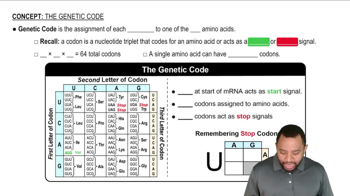
A codon is a sequence of three nucleotides in messenger RNA (mRNA) that specifies a particular amino acid or a stop signal during protein synthesis. Codons are read by the ribosome during translation, and each codon corresponds to a specific amino acid according to the genetic code. For example, the codon AUG codes for the amino acid methionine and also serves as the start signal for translation.
Video consigliato:
Percorso guidato
03:25
The Genetic Code Concept 1

Anticodon

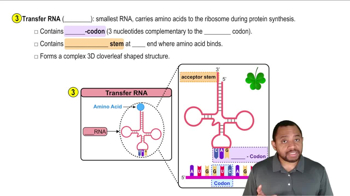
An anticodon is a sequence of three nucleotides found on transfer RNA (tRNA) that is complementary to a specific codon on mRNA. The anticodon allows tRNA to recognize and bind to the corresponding codon during protein synthesis, ensuring that the correct amino acid is added to the growing polypeptide chain. For instance, if the mRNA codon is UAC, the tRNA anticodon would be AUG, bringing in the appropriate amino acid.
Video consigliato:
Percorso guidato
2:23
Types of RNA Concept 2

Genetic Code

The genetic code is the set of rules by which information encoded in mRNA is translated into proteins. It consists of 64 codons that correspond to 20 amino acids and includes start and stop signals. The universality of the genetic code across different organisms highlights its fundamental role in biology, allowing for the translation of genetic information into functional proteins.
Video consigliato:
Percorso guidato
03:25
The Genetic Code Concept 1