Ch.18 Metabolic Pathways and ATP Production
Timberlake - Chemistry: An Introduction to General, Organic, and Biological Chemistry 14th Edition
Timberlake14th EditionChemistry: An Introduction to General, Organic, and Biological ChemistryISBN: 9781292472249Non è quello che usi tu?Cambia libro di testo
Capitolo 18, Problema 17

What coenzyme picks up hydrogen when a carbon–carbon double bond is formed?

Guida verificata passo dopo passo
1
Understand the context of the question: Coenzymes are molecules that assist enzymes in catalyzing reactions. In this case, the question refers to a reaction where a carbon–carbon double bond is formed, which typically involves the removal of hydrogen atoms (dehydrogenation).
Recall the role of coenzymes in redox reactions: Coenzymes like NAD⁺ (nicotinamide adenine dinucleotide) or FAD (flavin adenine dinucleotide) often act as electron carriers, picking up hydrogen atoms during oxidation reactions.
Identify the specific coenzyme involved: In reactions where a carbon–carbon double bond is formed, such as in the dehydrogenation of alkanes to alkenes, FAD is commonly the coenzyme that picks up hydrogen atoms.
Explain the mechanism: FAD accepts two hydrogen atoms (one proton and one hydride ion) to form FADH₂. This process helps stabilize the reaction and facilitates the formation of the double bond.
Summarize the answer: The coenzyme that picks up hydrogen when a carbon–carbon double bond is formed is FAD, which is reduced to FADH₂ in the process.

Risposta video verificata per un problema simile:

Questa soluzione video è stata consigliata dai nostri tutor come utile per risolvere questo problema.
Durata del video:
3m

Concetti chiave

Ecco i concetti essenziali che devi comprendere per rispondere correttamente alla domanda.

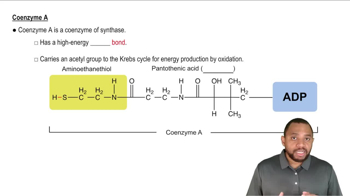
Coenzymes

Coenzymes are organic molecules that assist enzymes in catalyzing reactions. They often act as carriers for chemical groups or electrons during metabolic processes. In the context of biochemical reactions, coenzymes are crucial for facilitating the transfer of atoms or functional groups, thereby enhancing the efficiency of enzymatic activity.
Video consigliato:
Percorso guidato
1:02
Coenzyme A Concept 4

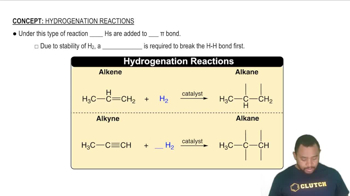
Hydrogenation

Hydrogenation is a chemical reaction that involves the addition of hydrogen (H2) to a carbon–carbon double bond, converting it into a single bond. This process is significant in organic chemistry and biochemistry, as it alters the saturation of organic compounds, impacting their reactivity and stability. Understanding hydrogenation is essential for grasping how certain coenzymes function in metabolic pathways.
Video consigliato:
Percorso guidato
1:22
Hydrogenation Reactions Concept 1

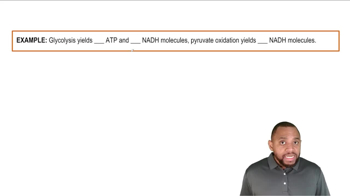
NADH

NADH (Nicotinamide adenine dinucleotide) is a key coenzyme in cellular metabolism that plays a vital role in redox reactions. It acts as an electron carrier, picking up hydrogen ions and electrons during metabolic processes, particularly in the conversion of substrates in glycolysis and the citric acid cycle. In the context of hydrogenation, NADH is often involved in the reduction of double bonds, making it essential for understanding the biochemical pathways that involve these reactions.
Video consigliato:
Percorso guidato
2:21
Total Energy From Glucose Example 1