Ch.2 Chemistry and Measurements
Timberlake - Chemistry: An Introduction to General, Organic, and Biological Chemistry 14th Edition
Timberlake14th EditionChemistry: An Introduction to General, Organic, and Biological ChemistryISBN: 9781292472249Non è quello che usi tu?Cambia libro di testo
Capitolo 2, Problema 54b

At Sandra's clinic, the medications in a. to d. are used. Write the equality and two conversion factors, and identify the numbers as exact or give the number of significant figures for each:
b. The Daily Value (DV) for selenium is 70. mcg.

Guida verificata passo dopo passo
1
Step 1: Write the equality based on the given information. The Daily Value (DV) for selenium is 70 mcg, which can be expressed as an equality: 1 DV=70 mcg.
Step 2: Create the first conversion factor using the equality. For example, 1DV / 70mcg.
Step 3: Create the second conversion factor by inverting the first conversion factor. For example, 70mcg / 1DV.
Step 4: Identify whether the number 70 is exact or has significant figures. Since the DV is a defined value, the number 70 is considered exact.
Step 5: Review the equality and conversion factors to ensure they are correctly formatted and can be used in calculations involving selenium dosage or DV comparisons.

Risposta video verificata per un problema simile:

Questa soluzione video è stata consigliata dai nostri tutor come utile per risolvere questo problema.
Durata del video:
3m

Concetti chiave

Ecco i concetti essenziali che devi comprendere per rispondere correttamente alla domanda.

Daily Value (DV)

The Daily Value (DV) is a reference value used on food labels to indicate how much a nutrient in a serving of food contributes to a daily diet. It helps consumers understand the nutritional content of food in the context of a total daily intake. For selenium, the DV is set at 70 micrograms (mcg), which serves as a guideline for adequate intake.
Video consigliato:
Percorso guidato
01:24
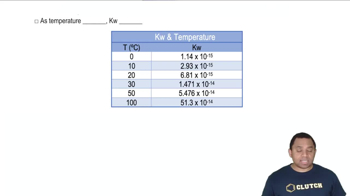
Kw and Temperature

Significant Figures

Significant figures are the digits in a number that contribute to its precision. This includes all non-zero digits, any zeros between significant digits, and trailing zeros in the decimal portion. Understanding significant figures is crucial for accurately reporting measurements and calculations, especially in scientific contexts where precision is vital.
Video consigliato:
Percorso guidato
01:09
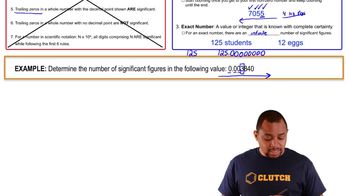
Significant Figures (Simplified) Example 2

Conversion Factors

Conversion factors are ratios used to convert a quantity expressed in one unit to another unit. They are essential in calculations involving different measurement systems, ensuring that the values remain equivalent. For example, to convert micrograms to milligrams, one would use the conversion factor of 1 mg = 1000 mcg.
Video consigliato:
Percorso guidato
03:45
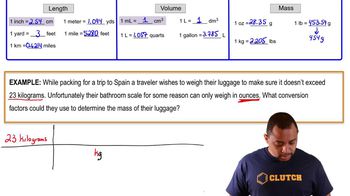
Conversion Factors (Simplified) Example 2