Ch.2 Chemistry and Measurements
Timberlake - Chemistry: An Introduction to General, Organic, and Biological Chemistry 14th Edition
Timberlake14th EditionChemistry: An Introduction to General, Organic, and Biological ChemistryISBN: 9781292472249Non è quello che usi tu?Cambia libro di testo
Capitolo 2, Problema 43b

For each of the following pairs, which is the larger unit?
b. milliliter or microliter

Guida verificata passo dopo passo
1
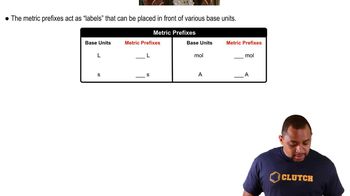
Understand the prefixes: 'milli-' means 10-3 (or 1/1000), and 'micro-' means 10-6 (or 1/1,000,000). These prefixes indicate the scale of the units relative to the base unit, which in this case is the liter.
Compare the two units: A milliliter (mL) is 10-3 liters, while a microliter (μL) is 10-6 liters. This means that 1 milliliter is equivalent to 1,000 microliters.
Determine which unit is larger: Since 1 milliliter equals 1,000 microliters, the milliliter is the larger unit.
Visualize the relationship: Think of it as comparing 1 to 1,000. A milliliter represents a larger volume than a microliter because it takes 1,000 microliters to equal 1 milliliter.
Conclude: The milliliter is the larger unit compared to the microliter.

Risposta video verificata per un problema simile:

Questa soluzione video è stata consigliata dai nostri tutor come utile per risolvere questo problema.
Durata del video:
1m

Concetti chiave

Ecco i concetti essenziali che devi comprendere per rispondere correttamente alla domanda.

Metric System

The metric system is a decimal-based system of measurement used globally, which includes units such as liters, milliliters, and microliters. It is structured around powers of ten, making conversions straightforward. Understanding this system is essential for comparing different units of volume.
Video consigliato:
Percorso guidato
01:16
Metric Prefixes

Volume Units

Volume units measure the amount of three-dimensional space an object occupies. In the metric system, common volume units include liters (L), milliliters (mL), and microliters (µL). Knowing the relationships between these units helps in determining which is larger or smaller.
Video consigliato:
Percorso guidato
01:15
Pressure Units Concept 1

Conversion Factors

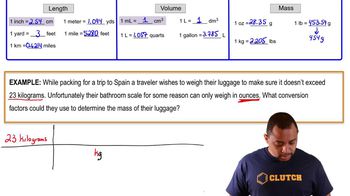
Conversion factors are numerical values used to convert one unit of measurement to another. For example, 1 milliliter equals 1,000 microliters. Understanding how to apply conversion factors is crucial for accurately comparing and converting between different volume units.
Video consigliato:
Percorso guidato
03:45
Conversion Factors (Simplified) Example 2