Ch.3 Matter and Energy
Timberlake - Chemistry: An Introduction to General, Organic, and Biological Chemistry 14th Edition
Timberlake14th EditionChemistry: An Introduction to General, Organic, and Biological ChemistryISBN: 9781292472249Non è quello che usi tu?Cambia libro di testo
Capitolo 3, Problema 97

A hot-water bottle for a patient contains 725 g of water at 65 °C. If the water cools to body temperature (37 °C), how many kilojoules of heat could be transferred to sore muscles?

Guida verificata passo dopo passo
1
Step 1: Identify the formula to calculate the heat transfer. The formula is: q = m ⁢ c ⁢ ∆ T , where q is the heat transferred, m is the mass of the water, c is the specific heat capacity of water, and ∆T is the change in temperature.
Step 2: Write down the known values. The mass of the water is 725 g, the initial temperature is 65 °C, the final temperature is 37 °C, and the specific heat capacity of water is 4.184 J/g·°C.
Step 3: Calculate the temperature change (∆T) by subtracting the final temperature from the initial temperature: ∆T = Tinitial - Tfinal.
Step 4: Substitute the known values into the formula. Convert the mass of water to kilograms if needed for the final answer in kilojoules. Use the formula: q = 725 ⁢ 4.184 ⁢ ( 65 - 37 ) .
Step 5: Convert the result from joules to kilojoules by dividing by 1000. This will give the heat transferred in kilojoules, which represents the energy available to be transferred to the sore muscles.

Risposta video verificata per un problema simile:

Questa soluzione video è stata consigliata dai nostri tutor come utile per risolvere questo problema.
Durata del video:
1m

Concetti chiave

Ecco i concetti essenziali che devi comprendere per rispondere correttamente alla domanda.

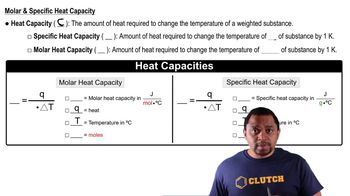
Specific Heat Capacity

Specific heat capacity is the amount of heat required to raise the temperature of a unit mass of a substance by one degree Celsius. For water, this value is approximately 4.18 J/g°C. Understanding this concept is crucial for calculating the heat transfer as it directly relates to how much energy is lost or gained when the temperature of water changes.
Video consigliato:

Heat Transfer

Heat transfer refers to the movement of thermal energy from one object or substance to another due to a temperature difference. In this scenario, the heat from the hot water bottle is transferred to the sore muscles, which can be quantified using the formula Q = mcΔT, where Q is the heat transferred, m is the mass, c is the specific heat capacity, and ΔT is the change in temperature.
Video consigliato:

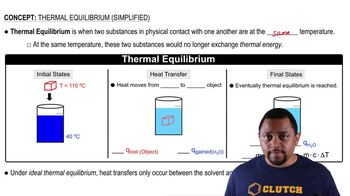
Thermal Equilibrium

Thermal equilibrium occurs when two objects in contact reach the same temperature, resulting in no net heat transfer between them. In this case, as the water cools from 65 °C to 37 °C, it approaches thermal equilibrium with the body, allowing the calculation of the total heat energy transferred to the muscles, which is essential for understanding the effectiveness of the hot-water bottle.
Video consigliato:
Percorso guidato
02:13
Thermal Equilibrium (Simplified) Concept 1