Ch.3 Matter and Energy
Timberlake - Chemistry: An Introduction to General, Organic, and Biological Chemistry 14th Edition
Timberlake14th EditionChemistry: An Introduction to General, Organic, and Biological ChemistryISBN: 9781292472249Non è quello che usi tu?Cambia libro di testo
Capitolo 3, Problema 68

After a week, biochemical reactions in compost slow, and the temperature drops to 45 °C. The dark brown organic-rich mixture is ready for use in the garden. What is this temperature in degrees Fahrenheit? In kelvins? (3.3)

Guida verificata passo dopo passo
1
Step 1: To convert the temperature from degrees Celsius to degrees Fahrenheit, use the formula: T(°F)=1.8×T(°C)+32. Substitute 45 °C into the formula.
Step 2: Perform the multiplication and addition in the formula to calculate the temperature in degrees Fahrenheit.
Step 3: To convert the temperature from degrees Celsius to kelvins, use the formula: T(K)=T(°C)+273.15. Substitute 45 °C into the formula.
Step 4: Perform the addition in the formula to calculate the temperature in kelvins.
Step 5: Verify your results to ensure the calculations are accurate and consistent with the formulas provided.

Risposta video verificata per un problema simile:

Questa soluzione video è stata consigliata dai nostri tutor come utile per risolvere questo problema.
Durata del video:
3m

Concetti chiave

Ecco i concetti essenziali che devi comprendere per rispondere correttamente alla domanda.

Temperature Conversion

Temperature conversion involves changing a temperature value from one unit to another, such as Celsius to Fahrenheit or Kelvin. The formulas for these conversions are: Fahrenheit (°F) = (Celsius × 9/5) + 32 and Kelvin (K) = Celsius + 273.15. Understanding these formulas is essential for accurately converting temperatures in scientific contexts.
Video consigliato:
Percorso guidato
03:45
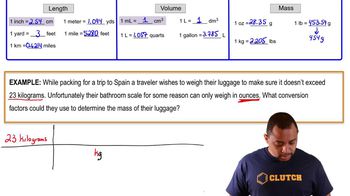
Conversion Factors (Simplified) Example 2

Biochemical Reactions in Composting

Biochemical reactions in composting are processes where microorganisms break down organic matter, resulting in nutrient-rich compost. These reactions are influenced by temperature, moisture, and oxygen levels, with optimal conditions promoting faster decomposition. Recognizing the role of temperature in these reactions helps explain why composting slows down as it cools.
Video consigliato:
Percorso guidato
1:08
Energy Production In Biochemical Pathways Example 1

Thermodynamics in Composting

Thermodynamics in composting refers to the energy changes and heat production during the decomposition of organic materials. As microorganisms metabolize organic matter, they generate heat, which raises the compost temperature. Understanding thermodynamics is crucial for managing composting processes effectively, ensuring optimal conditions for microbial activity.
Video consigliato:
Percorso guidato
01:18
First Law of Thermodynamics