Ch.3 Matter and Energy
Timberlake - Chemistry: An Introduction to General, Organic, and Biological Chemistry 14th Edition
Timberlake14th EditionChemistry: An Introduction to General, Organic, and Biological ChemistryISBN: 9781292472249Non è quello che usi tu?Cambia libro di testo
Capitolo 3, Problema 5b

Daniel suggests that Charle include one of the following mixtures in his diet. Classify each of the following as homogeneous or heterogeneous: b. tea

Guida verificata passo dopo passo
1
Step 1: Understand the definitions of homogeneous and heterogeneous mixtures. A homogeneous mixture has a uniform composition throughout, meaning its components are evenly distributed and indistinguishable. A heterogeneous mixture has a non-uniform composition, where the components are visibly distinct or unevenly distributed.
Step 2: Consider the example provided: tea. Think about whether tea has a uniform composition or if it contains visibly distinct components.
Step 3: If the tea is plain and well-mixed (e.g., brewed tea without any added solids like lemon slices or sugar that hasn't dissolved), it is likely a homogeneous mixture because the liquid appears uniform throughout.
Step 4: If the tea contains undissolved solids or visible components (e.g., tea leaves floating in the liquid or added ingredients like fruit pieces), it would be classified as a heterogeneous mixture due to the non-uniform composition.
Step 5: Based on the specific type of tea being referred to, classify it as either homogeneous or heterogeneous using the criteria outlined above.

Risposta video verificata per un problema simile:

Questa soluzione video è stata consigliata dai nostri tutor come utile per risolvere questo problema.
Durata del video:
42s

Concetti chiave

Ecco i concetti essenziali che devi comprendere per rispondere correttamente alla domanda.

Homogeneous Mixtures

Homogeneous mixtures are uniform in composition and appearance, meaning that the individual components are not distinguishable. An example is saltwater, where the salt is completely dissolved, creating a consistent solution. In such mixtures, any sample taken will have the same composition as any other sample.
Video consigliato:
Percorso guidato
02:35
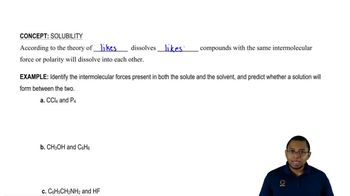
Solubility and Intermolecular Forces Concept 1

Heterogeneous Mixtures

Heterogeneous mixtures consist of visibly different substances or phases. The components can often be separated by physical means, and their proportions can vary throughout the mixture. An example is a salad, where you can see and identify the individual ingredients like lettuce, tomatoes, and cucumbers.
Video consigliato:
Percorso guidato
02:35
Solubility and Intermolecular Forces Concept 1

Classification of Mixtures

The classification of mixtures into homogeneous and heterogeneous is essential for understanding their properties and behaviors. This classification helps in various fields, including chemistry and nutrition, as it influences how substances interact and how they can be processed or consumed. Recognizing the type of mixture can also affect dietary choices and health implications.
Video consigliato:
Percorso guidato
04:19
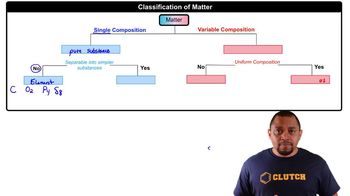
Classification of Matter