Ch.3 Matter and Energy
Timberlake - Chemistry: An Introduction to General, Organic, and Biological Chemistry 14th Edition
Timberlake14th EditionChemistry: An Introduction to General, Organic, and Biological ChemistryISBN: 9781292472249Non è quello che usi tu?Cambia libro di testo
Capitolo 3, Problema 46d

Identify each of the following changes of state as melting, freezing, sublimation, or deposition:
d. Frost (ice) forms on the walls of a freezer unit of a refrigerator.

Guida verificata passo dopo passo
1
Step 1: Understand the process described in the problem. Frost forming on the walls of a freezer involves water vapor in the air turning directly into solid ice without becoming liquid first.
Step 2: Recall the definition of deposition. Deposition is the phase change where a substance transitions directly from the gas phase to the solid phase, bypassing the liquid phase.
Step 3: Compare the described process to the definition of deposition. Since water vapor (gas) is turning into ice (solid) directly, this matches the definition of deposition.
Step 4: Confirm that no intermediate liquid phase is involved. The problem explicitly describes frost forming directly from water vapor, which is characteristic of deposition.
Step 5: Conclude that the change of state described in the problem is deposition.

Risposta video verificata per un problema simile:

Questa soluzione video è stata consigliata dai nostri tutor come utile per risolvere questo problema.
Durata del video:
1m

Concetti chiave

Ecco i concetti essenziali che devi comprendere per rispondere correttamente alla domanda.

Deposition

Deposition is the process in which a gas transforms directly into a solid without passing through the liquid state. This occurs when the temperature and pressure conditions favor the solid phase, leading to the formation of solid particles from vapor. An example of deposition is the formation of frost on surfaces, where water vapor in the air freezes directly into ice.
Video consigliato:
Percorso guidato
1:50
Tollens' Test Concept 2

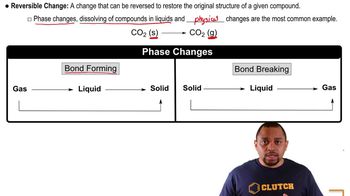
Phase Changes

Phase changes refer to the transitions between different states of matter: solid, liquid, and gas. These changes occur due to variations in temperature and pressure, affecting the energy and arrangement of particles. Understanding phase changes is crucial for identifying processes like melting, freezing, sublimation, and deposition, as they describe how substances behave under different conditions.
Video consigliato:
Percorso guidato
03:40
Physical & Chemical Changes

Thermodynamics

Thermodynamics is the branch of physics that deals with heat, work, and energy transfer. It provides the principles governing phase changes, including the energy required for a substance to change from one state to another. In the context of deposition, thermodynamic principles explain how energy loss from water vapor leads to the formation of frost when it cools and solidifies on surfaces.
Video consigliato:
Percorso guidato
01:18
First Law of Thermodynamics