Ch.4 Atoms and Elements
Timberlake - Chemistry: An Introduction to General, Organic, and Biological Chemistry 14th Edition
Timberlake14th EditionChemistry: An Introduction to General, Organic, and Biological ChemistryISBN: 9781292472249Non è quello che usi tu?Cambia libro di testo
Capitolo 4, Problema 82b

Match the subatomic particles (1 to 3) to each of the descriptions below:
1. protons
2. neutrons
3. electrons
b. surround the nucleus

Guida verificata passo dopo passo
1
Identify the three subatomic particles: protons, neutrons, and electrons. Protons and neutrons are located in the nucleus, while electrons are found outside the nucleus.
Understand the description provided: 'surround the nucleus.' This refers to the region outside the nucleus where subatomic particles are located.
Recall that electrons are negatively charged particles that move in regions of space called orbitals around the nucleus.
Match the description 'surround the nucleus' to the subatomic particle that fits this behavior, which is the electron.
Conclude that the correct match for the description 'surround the nucleus' is the subatomic particle labeled as '3. electrons.'

Risposta video verificata per un problema simile:

Questa soluzione video è stata consigliata dai nostri tutor come utile per risolvere questo problema.
Durata del video:
49s

Concetti chiave

Ecco i concetti essenziali che devi comprendere per rispondere correttamente alla domanda.

Subatomic Particles

Subatomic particles are the fundamental constituents of atoms, which include protons, neutrons, and electrons. Protons carry a positive charge and are found in the nucleus, while neutrons are neutral and also reside in the nucleus. Electrons, on the other hand, are negatively charged and orbit the nucleus in various energy levels.
Video consigliato:
Percorso guidato
01:25
Subatomic Particles (Simplified) Concept 1

Atomic Structure

The atomic structure refers to the arrangement of subatomic particles within an atom. The nucleus, composed of protons and neutrons, is at the center, while electrons occupy regions around the nucleus, known as electron shells or orbitals. This structure is crucial for understanding chemical behavior and bonding.
Video consigliato:

Electron Configuration

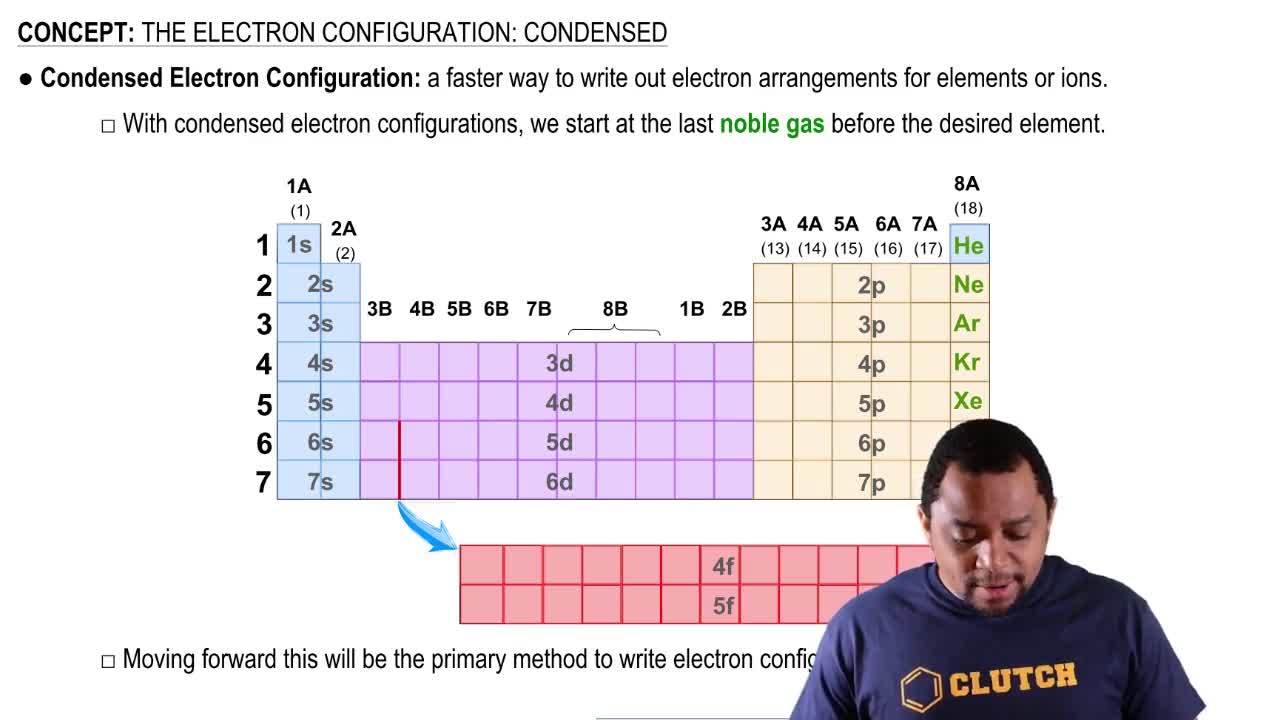
Electron configuration describes the distribution of electrons in an atom's electron shells. Electrons fill these shells based on specific rules, such as the Aufbau principle, which states that electrons occupy the lowest energy levels first. This configuration influences an atom's reactivity and the types of bonds it can form.
Video consigliato:
Percorso guidato
01:08
The Electron Configuration: Condensed