Ch.4 Atoms and Elements
Timberlake - Chemistry: An Introduction to General, Organic, and Biological Chemistry 14th Edition
Timberlake14th EditionChemistry: An Introduction to General, Organic, and Biological ChemistryISBN: 9781292472249Non è quello che usi tu?Cambia libro di testo
Capitolo 4, Problema 103a,b

Provide the following:
a. the atomic number and symbol of the lightest alkali metal
b. the atomic number and symbol of the heaviest noble gas

Guida verificata passo dopo passo
1
Step 1: Recall the periodic table groups. Alkali metals are in Group 1, and noble gases are in Group 18.
Step 2: Identify the lightest alkali metal. The lightest alkali metal is hydrogen (H), but it is not typically classified as an alkali metal. The next lightest alkali metal is lithium (Li). Its atomic number is 3.
Step 3: Identify the heaviest noble gas. Noble gases are located in Group 18, and the heaviest noble gas is oganesson (Og). Its atomic number is 118.
Step 4: Write down the atomic number and symbol for lithium (Li) and oganesson (Og). Lithium has an atomic number of 3, and oganesson has an atomic number of 118.
Step 5: Verify your answers using the periodic table to ensure the atomic numbers and symbols are correct.

Concetti chiave

Ecco i concetti essenziali che devi comprendere per rispondere correttamente alla domanda.

Alkali Metals

Alkali metals are a group of elements found in Group 1 of the periodic table, characterized by their single valence electron, which makes them highly reactive. The lightest alkali metal is lithium, with an atomic number of 3 and the symbol 'Li'. These metals are known for their low density and are typically found in nature only in compound form.
Video consigliato:
Percorso guidato
01:08
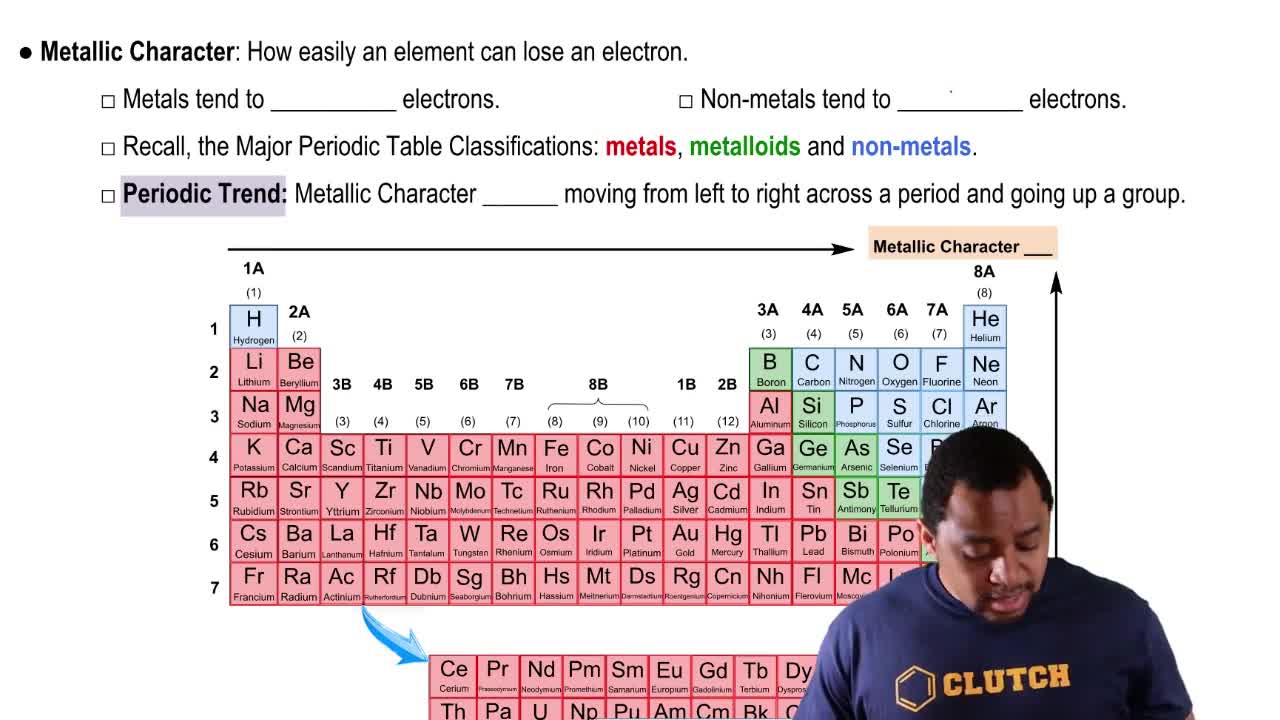
Periodic Trend: Metallic Character

Noble Gases

Noble gases are located in Group 18 of the periodic table and are known for their lack of reactivity due to having a full valence shell of electrons. The heaviest noble gas is radon, which has an atomic number of 86 and the symbol 'Rn'. These gases are colorless, odorless, and exist in a gaseous state at room temperature.
Video consigliato:
Percorso guidato
14:42
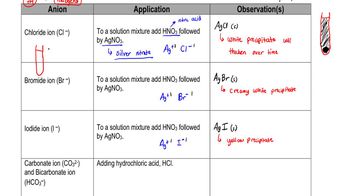
Test for Anions

Atomic Number and Symbol

The atomic number of an element is the number of protons found in the nucleus of an atom, which determines the element's identity and its position in the periodic table. Each element is also represented by a unique chemical symbol, typically one or two letters derived from its name, such as 'Li' for lithium and 'Rn' for radon. Understanding these concepts is essential for identifying elements and their properties.
Video consigliato:
Percorso guidato
04:01
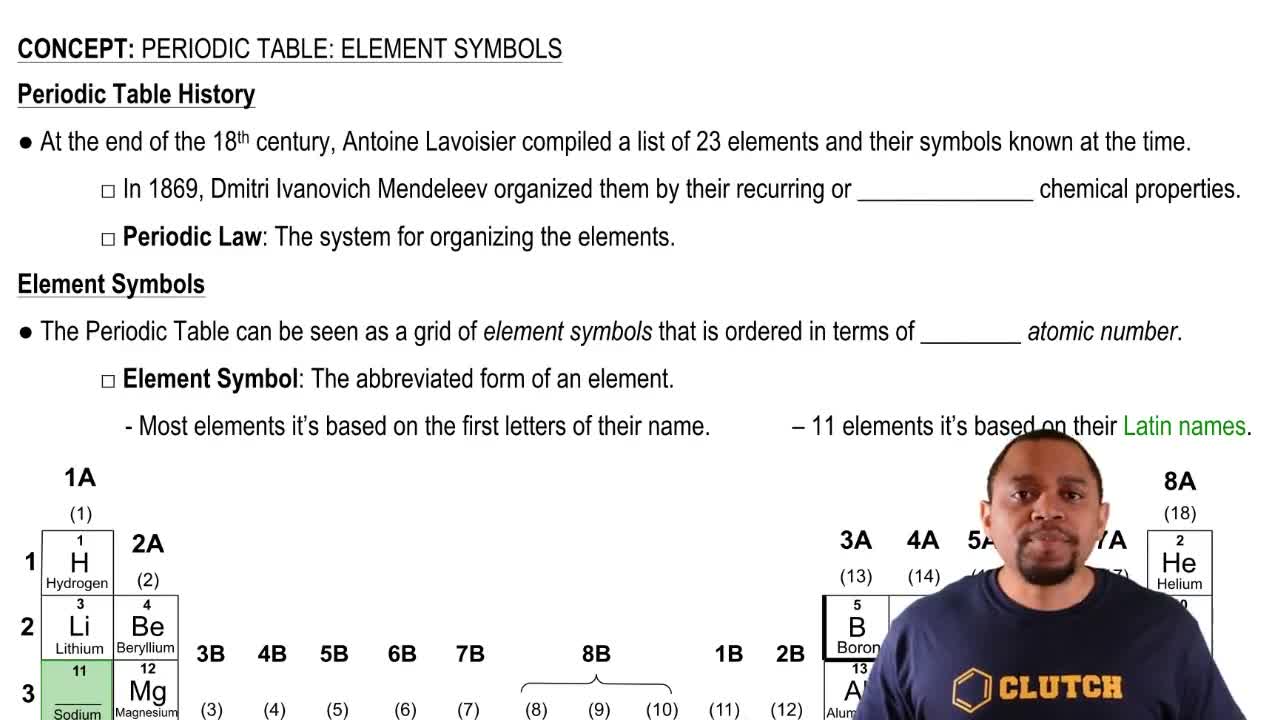
Periodic Table: Symbols Concept