Suppose a person absorbed 50 mrad of alpha radiation. What would be the equivalent dose in millisieverts?
Ch.5 Nuclear Chemistry
Timberlake14th EditionChemistry: An Introduction to General, Organic, and Biological ChemistryISBN: 9781292472249Non è quello che usi tu?Cambia libro di testo
Capitolo 5, Problema 26
Two samples of a radioisotope were spilled in a nuclear laboratory. The activity of one sample was 8 kBq and the other 15 mCi. Which sample produced the higher amount of radiation?
Guida verificata passo dopo passo1
Understand the problem: The activity of the two samples is given in different units (kBq and mCi). To compare them, we need to convert both activities into the same unit.
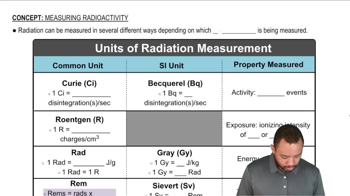
Recall the unit conversion factors: 1 Ci (Curie) = 3.7 × 10^10 Bq (Becquerel). Therefore, 1 mCi (millicurie) = 3.7 × 10^7 Bq.
Convert the activity of the second sample from mCi to Bq using the formula: \( \text{Activity in Bq} = \text{Activity in mCi} imes 3.7 imes 10^7 \). Substitute 15 mCi into the formula.
Compare the activity of the first sample (8 kBq, which is \( 8 imes 10^3 \) Bq) with the converted activity of the second sample in Bq.
Determine which sample has the higher activity based on the comparison of the two values in Bq.

Risposta video verificata per un problema simile:
Questa soluzione video è stata consigliata dai nostri tutor come utile per risolvere questo problema.
Durata del video:
1mConcetti chiave
Ecco i concetti essenziali che devi comprendere per rispondere correttamente alla domanda.
Radioactivity
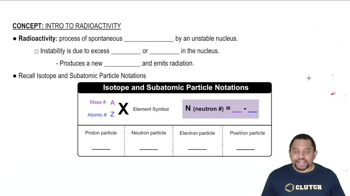
Radioactivity is the process by which unstable atomic nuclei lose energy by emitting radiation. This can occur in the form of alpha particles, beta particles, or gamma rays. The rate of decay is measured in terms of activity, which indicates how many disintegrations occur per unit time, typically expressed in becquerels (Bq) or curies (Ci). Understanding radioactivity is essential for comparing the radiation emitted by different samples.
Video consigliato:
Percorso guidato
Measuring Radioactivity Concept 1
Units of Measurement
Radioactivity is measured in various units, with the becquerel (Bq) and curie (Ci) being the most common. One becquerel corresponds to one disintegration per second, while one curie is equivalent to 37 billion disintegrations per second. To compare the activity of the two samples effectively, it is crucial to convert them into the same unit, allowing for a direct comparison of their radiation output.
Video consigliato:
Percorso guidato
Measuring Radioactivity Concept 1
Radiation Dose
Radiation dose refers to the amount of radiation energy absorbed by a material or biological tissue. It is important to understand that higher activity levels in radioisotopes can lead to greater radiation doses, which can have significant health implications. By analyzing the activity of the samples, one can determine which sample poses a greater risk in terms of radiation exposure.
Video consigliato:
Percorso guidato
Intro to Radioactivity
Pratica correlata
Domanda del libro di testo
1185
views
Domanda del libro di testo
Complete each of the following bombardment reactions:
d. ? + 6428Ni → 272111Rg + 10n
1574
views
Domanda del libro di testo
For each of the following, indicate if the number of half-lives elapsed is:
1. one half-life
2. two half-lives
3. three half-lives
c. a sample of Au-198 with a half-life of 2.7 days after 5.4 days
1095
views
Domanda del libro di testo
The dosage of technicium-99m for a lung scan is 20. µCi/kg of body mass. How many millicuries of technicium-99m should be given to a person weighing 50. kg (1 mCi = 1000 µCi)
45
views
Domanda del libro di testo
Match each property (1 to 3) with its unit of measurement.
1. activity
2. absorbed dose
3. biological damage
a. rad
842
views
Domanda del libro di testo
Two technicians in a nuclear laboratory were accidentally exposed to radiation. If one was exposed to 8 mGy and the other to 5 rad, which technician received more radiation?
777
views