Ch.6 Ionic and Molecular Compounds
Timberlake - Chemistry: An Introduction to General, Organic, and Biological Chemistry 14th Edition
Timberlake14th EditionChemistry: An Introduction to General, Organic, and Biological ChemistryISBN: 9781292472249Non è quello che usi tu?Cambia libro di testo
Capitolo 6, Problema 97d

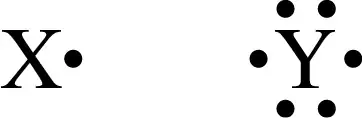
Consider the following Lewis symbols for elements X and Y:
Lewis dot symbols for elements X and Y, illustrating their valence electrons for ion formation analysis.
d. What would be the formula of a compound of X and Y?

Guida verificata passo dopo passo
1
Step 1: Identify the valence electrons for elements X and Y based on their Lewis symbols. The number of dots around the element symbol represents the number of valence electrons.
Step 2: Determine the number of electrons each element needs to achieve a full octet (8 valence electrons). For example, if X has 6 valence electrons, it needs 2 more electrons, and if Y has 1 valence electron, it needs to lose 1 electron to achieve a stable configuration.
Step 3: Analyze the ratio in which X and Y will combine to satisfy the octet rule for both elements. For instance, if X needs 2 electrons and Y can donate 1 electron, the ratio of X:Y would be 1:2.
Step 4: Write the chemical formula of the compound by combining X and Y in the ratio determined in the previous step. Use subscripts to indicate the number of each type of atom in the compound.
Step 5: Verify the formula by ensuring that the total number of electrons gained and lost by the elements results in a stable configuration for both X and Y.

Risposta video verificata per un problema simile:

Questa soluzione video è stata consigliata dai nostri tutor come utile per risolvere questo problema.
Durata del video:
1m

Concetti chiave

Ecco i concetti essenziali che devi comprendere per rispondere correttamente alla domanda.

Lewis Symbols

Lewis symbols are a way to represent the valence electrons of an atom using dots around the element's symbol. Each dot corresponds to a valence electron, which plays a crucial role in chemical bonding. Understanding Lewis symbols helps predict how atoms will interact and bond with each other to form compounds.
Video consigliato:
Percorso guidato
01:27
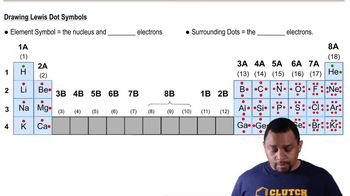
Lewis Dot Symbols (Simplified) Concept 2

Chemical Bonding

Chemical bonding refers to the forces that hold atoms together in a compound. The two primary types of bonds are ionic and covalent. Ionic bonds occur when electrons are transferred from one atom to another, while covalent bonds involve the sharing of electrons. The type of bond formed between elements X and Y will influence the compound's formula.
Video consigliato:
Percorso guidato
00:49
Chemical Reaction: Chemical Change Example 1

Empirical Formula

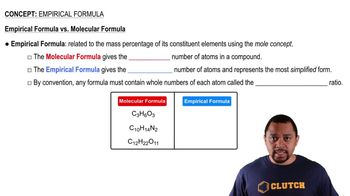
The empirical formula of a compound represents the simplest whole-number ratio of the elements present. It is derived from the number of atoms of each element in the compound. To determine the empirical formula of the compound formed by elements X and Y, one must consider their valence and the type of bond they form, which will dictate the ratio of X to Y in the compound.
Video consigliato:
Percorso guidato
02:26
Empirical Formula